Get the world’s most fascinating discoveries delivered straight to your inbox.
You are now subscribed
Your newsletter sign-up was successful
Want to add more newsletters?
Join the club
Get full access to premium articles, exclusive features and a growing list of member rewards.
An account already exists for this email address, please log in.
10 temples, tombs and monuments that align with the summer solstice
From the Mediterranean to North America, there's a lot of evidence that the day the 'sun stands still' has been important to humans for thousands of years.
On Wednesday, June 21 at 10:57 a.m. ET (14:57 UTC) the sun will reach its highest point in the Northern Hemisphere, bringing the longest day of the year — the summer solstice.
Sunrise and sunset on the summer solstice appear to have fascinated humans for thousands of years. While at the equinoxes — when the sun appears directly above the equator — the sun rises and sets due east and west, respectively, during June's solstice it rises in the northeast and sets in the northwest. Across the world, there are hundreds of monuments, temples and other buildings aligned to the solstice. Here are 10 intriguing examples.
1. Stonehenge, Wiltshire, UK
(Image credit: Getty)
One of the most famous monuments aligned with the summer solstice is Stonehenge. This 5,000-year-old Neolithic monument's Heel Stone is lit up by the rising sun immediately before the summer solstice, and thousands of people spend the night around this mysterious ring of standing stones to witness the event. Livestream the event from 11:00 p.m. ET on June 20, 2023, on English Heritage's Facebook page, with the solstice sun rising at 11:49 p.m. ET.
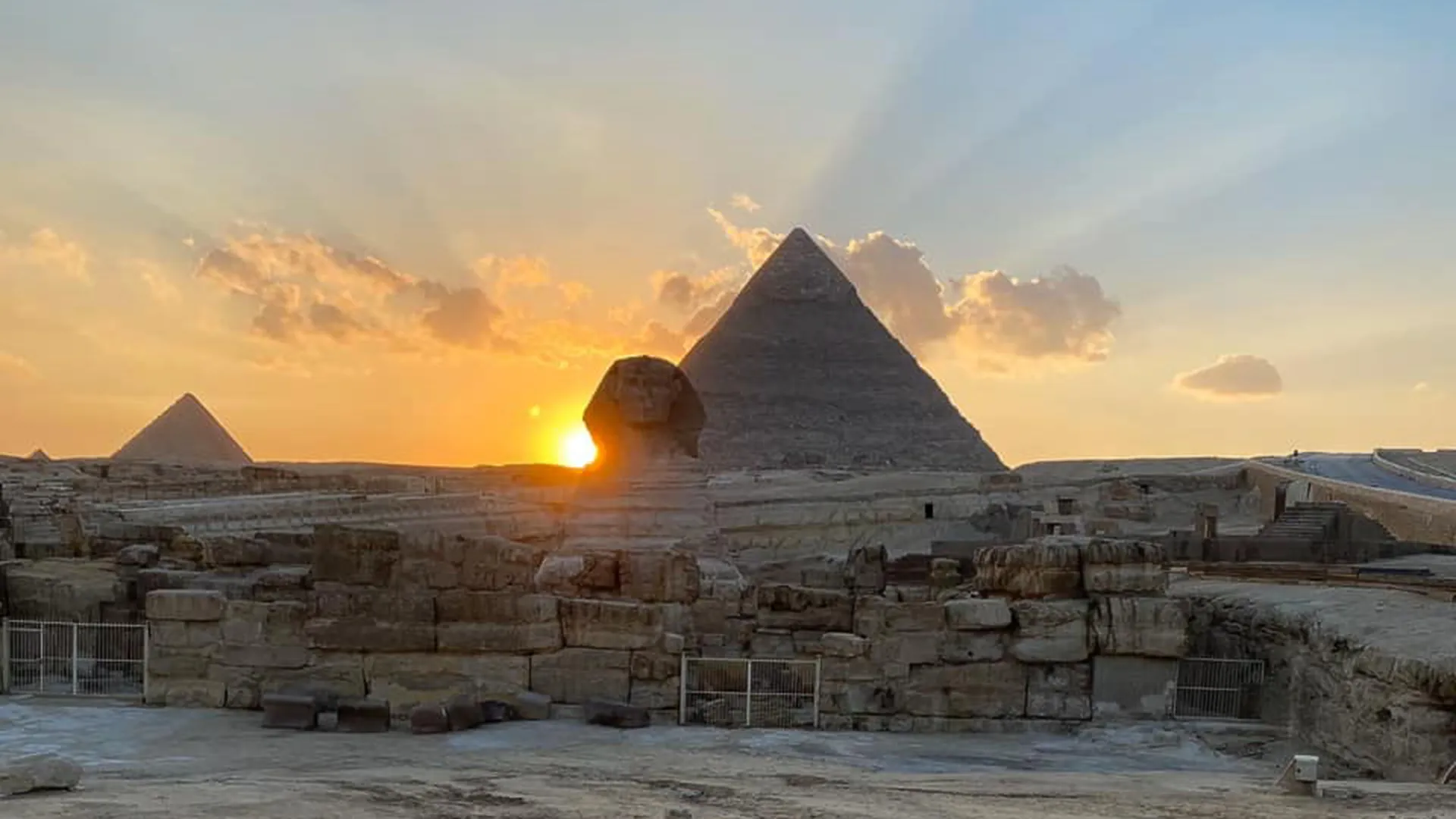
The 4,500-year-old Pyramids of Giza are known mostly for being the tallest standing human-made structures until 1311, but it's perhaps less known that they are aligned to the cardinal points. From in front of the Sphinx, the sunset on the solstice takes place between the Khafra and Khufu pyramids. Around the equinoxes, the sunset takes place on the shoulder of the half-man, half-lion statue.
3. Chaco Canyon, New Mexico, USA
(Image credit: Getty)
Chaco Culture National Historical Park, in a remote canyon in northwestern New Mexico, hides huge structures called kiva built by the Ancestral Puebloan people between A.D. 850 and 1250. Be at Casa Rinconada — a "great kiva" — for sunrise on the day of the summer solstice (and a few sunrises on either side) and you'll see a rectangle of light shine through a window and settle in a niche.
4. Piedras Blancas, Antequera, Spain
(Image credit: Courtesy of ATLAS research group, University of Seville)
Archaeologists are discovering monuments that align with the sun all the time. In May 2023 archaeologists in Andalusia, southern Spain reported their discovery of a 5,400-year-old tomb in a region known for its megaliths. The solstice sunrise lights up decorative rocks on the walls of a chamber deep within. The site is at the foot of a prominent mountain called La Peña de los Enamorados, which the nearby (and much more famous) Dolmen de Menga is aligned with.
5. Sun Tunnels, Great Basin Desert, Utah, USA
(Image credit: Getty)
Not all aligned monuments are thousands of years old. The Sun Tunnels, a modern art creation constructed between 1973 and 1976 in the Great Basin Desert in northwestern Utah, is the work of artist Nancy Holt. The installation consists of four massive concrete cylinders that are separately aligned with sunrise and sunset on the summer and winter solstices.
Sign up for the Live Science daily newsletter now
Get the world’s most fascinating discoveries delivered straight to your inbox.
6. Puerco Pueblo, Petrified Forest National Park, Arizona, USA
(Image credit: National Park Service)
The prehistoric people of the Southwest U.S. appear to have used the solstice to create ancient calendars. One of the most famous of these is a petroglyph at Puerco Pueblo, where a shaft of sunlight is projected onto a spiral solstice marker on a boulder, touching its center about 9 a.m local time. This happens each morning for about a two-week period around the summer solstice. Close by is Newspaper Rock State Historic Monument, a rock face with over 650 petroglyphs.
7. Hagar Qim, Malta
(Image credit: Getty)
A spectacular megalithic temple on the Mediterranean island of Malta, Hagar Qim is one of the oldest free-standing buildings in the world. It was constructed between around 3600 to 3200 B.C. At sunrise on the summer solstice, the first rays of the rising sun enter the structure through an elliptical "oracle hole" in the monumental walls, which projects the disk of the sun onto a stone slab.
These three vertical standing stones, oriented northeast to southwest, may not look like much, but they're thought to be an ancient observatory. The three stones align with sunset on the day of the solstice, with the sun setting behind mountains on the Isle of Jura.
9. Kensington Gardens, London, UK
(Image credit: Getty)
Sometimes solstice alignments are hiding in plain sight. Kensington Gardens, which has been inhabited by members of the British monarchy since 1689, is no exception. In 2017, a physics professor calculated that one of the main avenues radiating out from its Round Pond is oriented for sunrise on the summer solstice.
10. Parowan Gap, Iron County, Utah, USA
(Image credit: An Errant Knight/ Wikimedia Commons/ CC-BY-SA-4.0)
Just northwest of Cedar City in southern Utah is a 600-foot (180 meters) V-shaped gap in the mountains that the sun appears to roll down at sunset, when seen from the east. The phenomenon can be observed any evening depending on where the viewer stands, but cairns mark the exact places to stand on the summer and winter solstices. The cairns are thought to have been put there about 10,000 years ago by Fremont and Paiute Native American people. Within the Parowan Gap itself is a vast panel of petroglyphs, one of which is V-shaped and thought to represent the alignments as a solar calendar.
Jamie Carter is a Cardiff, U.K.-based freelance science journalist and a regular contributor to Live Science. He is the author of A Stargazing Program For Beginners and co-author of The Eclipse Effect, and leads international stargazing and eclipse-chasing tours. His work appears regularly in Space.com, Forbes, New Scientist, BBC Sky at Night, Sky & Telescope, and other major science and astronomy publications. He is also the editor of WhenIsTheNextEclipse.com.