













Bold jumping spiders can literally go blind with hunger
Researchers have found that undernourished bold jumping spiders begin to lose light-sensitive photoreceptors.
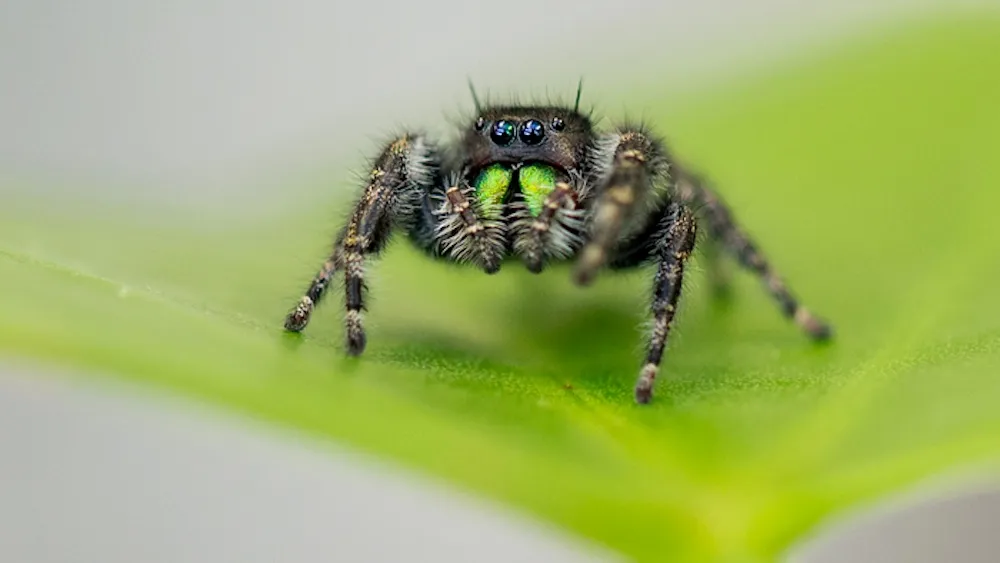
Spiders have a keen sense of sight, but once they begin to starve they also start to go blind.
Biologists made the startling discovery while studying the eyes of bold jumping spiders (Phidippus audax) in the lab. They found that when they decreased the diets of these tiny hunters, the spiders' vision decreased too, according to a study published in the May issue of the journal Vision Research.
"We started looking at their eyes and noticed dark spots that suggested degeneration," study co-author Elke Buschbeck, a professor in the department of biological sciences at the University of Cincinnati, told Live Science. "We were really surprised and not expecting that."
Jumping spiders have high-resolution color vision, which they see with their principal, forward-facing eyes. (They also have side eyes for black-and-white vision.) Buschbeck thinks that studying these spiders could provide insight into the role nutrition plays in human eye diseases such as macular degeneration.
The spiders’ degenerating eyesight was initially spotted by one of Buschbeck’s undergraduate students, Miranda Brafford, who was examining the eyes of several of the wild-caught spiders using the lab's custom-built ophthalmoscope — a device designed to take fluorescent images of the retinas of animals with teensy eyes, such as spiders and insects. Brafford, who is a co-author of the study, noticed that some of the spiders had developed spots on their photoreceptors, which are cells that convert light into signals that are sent from the eyes to the brain. The spots suggested that the spiders' eyesight had degenerated. They then used electron microscopy to examine thin cross sections of the photoreceptors to confirm that the cells were indeed dying, according to an April 20 statement.
Related: Female spiders play dead during sex so males don't have to worry about being eaten
To test their theory that poor nutrition was the culprit, the team divided the spiders into two groups: One was fed a normal diet of crickets and bee pollen while the other received half portions.
Get the world’s most fascinating discoveries delivered straight to your inbox.
"The condition of the eyes of the spiders with less nutrition was much worse," Buschbeck said. "We could tell just by looking at them with the ophthalmoscope that some of their photoreceptors had died."
The researchers think that this shift in vision could be because photoreceptors require a lot of energy in the form of nutrients to function optimally, and if they don't receive a sufficient energy supply "the system fails," according to the statement.
RELATED STORIES
While humans aren't spiders, "the photoreceptor mechanism is very similar" between the two species. So something similar could be at play in people with macular degeneration, though more research would be needed to show that, Buschbeck said.
"In both cases, it has something to do with energy metabolism and those photoreceptor cells, which are extremely energetically costly," Buschbeck said. "It's not easy for an organism to keep up with their energy needs [when nutritionally deprived]."
Jennifer Nalewicki is former Live Science staff writer and Salt Lake City-based journalist whose work has been featured in The New York Times, Smithsonian Magazine, Scientific American, Popular Mechanics and more. She covers several science topics from planet Earth to paleontology and archaeology to health and culture. Prior to freelancing, Jennifer held an Editor role at Time Inc. Jennifer has a bachelor's degree in Journalism from The University of Texas at Austin.