













'It was clearly a human assault on the species': The fate of the great auk
Author and professor Gísli Pálsson details the final years of the North Atlantic flightless birds that were driven to extinction by humans — an event that caused a moment of realization about humanity's destructive powers.


Great auks (Pinguinus impennis) were large flightless birds that thrived on rocky islands in the North Atlantic for thousands of years. However, humans hunted them to extinction within just a few hundred years, targeting the auks for their feathers, fat, meat and oil. The last breeding pair was killed by a fisher off the coast of Iceland in 1844, and the last sighting — of a single male, and potentially the last of its species — was off the Newfoundland Banks in 1852.
In his new book, "The Last of Its Kind: The Search for the Great Auk and the Discovery of Extinction" (Princeton University Press, 2024), anthropologist Gísli Pálsson recounts the final years of the great auk, using accounts and interviews from Victorian ornithologists John Wolley and Alfred Newton, who realized that species extinction was not something confined to the past but a tangible process that humans can cause.
In an interview with Live Science, Pálsson discusses the background to the book, the lasting legacy of the great auks' demise and whether the species could or should be resurrected.
Alexander McNamara: What is a great auk, and what happened to it?
Gísli Pálsson: The great auk was a tall bird — 80 centimeters [31 inches] and quite thick with lots of meat — and it was flightless so would nest on skerries [small rocky islands] where it could climb up. [It lived] In various spots along the North Atlantic and in North America, and humans exploited it for millennia — the oldest images we have [are] from a cave in France, close to Marseille from 27,000 years ago. The biggest colony was probably in Newfoundland and Indigenous groups in North America hunted it for quite a long time. We have early anthropological reports and archaeological evidence, but this was largely for religious events, and symbolism, [for example] the Beothuk [Indigenous people] captured eggs and used them in rituals.
The great auk was hunted in the Scottish Isles, Norway, Iceland and some other places — but the major slaughterhouse of the great auks was in Newfoundland. It was European sailors, French and Portuguese, in the 16th and 17th centuries. They would hunt great auks in their thousands, decimating the local stock. At the same time, they would kill the Beothuk, and so this was genocide plus near extinction of the great auks. The European sailors were there to catch fish, but they needed food on the way back, so would fill their boats with great auk, salt the meat and sail on to Europe. Some of my colleagues have [said] this was the first fast food stop in the world.
Iceland was also an important colony. There are old Icelandic maps that show several great auk skerries, but the main colonies were in the south, close to where the recent eruptions are. For centuries [the biggest] was probably the great auk skerry, which sank in an eruption in 1830, so the bird had to find new breeding grounds. From 1830 to 1844, it would nest on the famous Eldey, which means Fire Island, and that's the place where the last pair was caught on June 18, 1844.
Get the world’s most fascinating discoveries delivered straight to your inbox.
AM: How do we know about the final days of the great auk?
Miraculously a pair of British naturalists [John Wolley and Alfred Newton] came to Iceland in 1858, 14 years after the final pair was killed. They wouldn't know that, but they were hoping to get a bird or two and an egg for the museums and their studies. They were unable to go to Eldey because the foreman they had hired said it was too risky. Entire crews have been killed in the battle with the island and the ocean — it's a long history of drownings and accidents. So they were stuck on southwest Iceland, terribly disappointed they couldn't get to the island. Instead, they decided to take interviews and notes. John Wolley wrote five notebooks, the "Gare-Fowl Books" [which are] now stored in Cambridge University library. He died a year after the expedition to Iceland, but Newton lived on.
Related stories: 'Closer than people think': Woolly mammoth 'de-extinction' is nearing reality — and we have no idea what happens next
[After six weeks, they] returned to England, and Newton became the first professor of zoology in Cambridge and quite a big name in environmental protection and in bird studies. When I came somewhat accidentally across the "Gare-Fowl Books" I was stunned. I sort of doubted if the source existed and was readable. I decided to buy a copy, digital images of the whole thing, 900 pages, and it would take me months to read the handwriting and to transcribe some of the key points I saw in the interviews.
This was the meat of my book, but in the middle of writing, it dawned upon me that I had a vital source in my hands that no one had really tracked thoroughly. This was evidence of an extinction, and evidence which eventually led to the recognition of extinction as an epistemic fact, something to be explored and scrutinized by scholars. I also realized that I was uniquely placed, if I can say so myself, to write the story — I grew up in a fishing community, and knew the culture and the language. I had done PhD fieldwork right in that spot, only a couple of miles from the international airport.

An 1836 illustration of great auks by Robert Havell.
AM: So clearly Newton and Wolley went to great expense to find the bird, why was it so valuable?
GP: The slaughtering on Newfoundland had a massive impact. These were small pockets of great auks, surviving on small islands and skerries along the North Atlantic. In the meantime, museums became a big thing in the British Empire and the Victorian times. Empires had to flag the flora and fauna of their colonies, and they began competing for rare animals or plants. It became an economic spiral. The harder the competition for eggs, skins, or bones, the fewer were still around, so the price would go up.
Merchants and scientists would hire fishers, typically to go and hunt for auks, but nobody realized at the time that extinction was approaching. It wasn't a thing. The peasants that Newton and Wolley spoke to, they were not speaking about the extinction, and I cannot find extinction in the 900 pages written in 1858. And yet, [the great auk] became the signature of human caused extinction. The peasants said that there was no indication that they would worry about the end of this species, they imagined that the remaining breeding population would be momentarily nesting in the Faroes and Greenland. The consensus was that the species numbers were declining and the competition was harder, but sure, there were lots of birds around.
AM: What did we think was happening to these animals before we realized extinction was a thing?
GP: I think people realized that there were swings in stock sizes. Lots of Westerners were aware of the dodo a century earlier than the great auk, and some naturalists, American and British, had spoken of disappearance of species and the role of humans. So something was brewing in the 18th and early 19th centuries.
[Previously] everyone was obsessed with species just being there permanently, as [Carl] Linnaeus had argued and [Charles] Darwin imagined, that extinction was a thing about the past, long in the historical and fossil record. Later on, people began to realize that extinction by humans was a very serious thing. Alfred Newton, as I argue in the book, deserves credit for pushing that idea.
It seems that Newton had this ability to notice things. This happened over a few years. He comes from Iceland in 1858 packed with notes, and he knows that the bird hasn't been seen in Iceland for 14 years, but still has faith that the bird is still around. But a year or two later, Newton begins to sense that it's completely gone. No one has seen it or reported it. So then he begins to become a kind of activist, establishing or joining bird protection societies. His key point is that [other] species may be increasingly disappearing in the fashion of the great auk.
I didn't quite realize this until late in my writing process, and diving again and again into the "Gare-fowl" manuscripts and Newton's writing, I finally was convinced that he was anticipating something that no one had done — namely serious extinction. He said, extinction is a processual thing and in a sense, extinction of the great auk began in Newfoundland in the 16th century. I spotted some writings of Newton in a footnote saying that the great auk was killed by humans.
Interestingly, we have genetic evidence recently supporting Newton's argument. The evidence indicates the genetic variety was sufficient enough to withstand shifts in habitat and climate. So arguably, on genetic grounds, it was clearly a human assault on the species.
AM: Is there anything that we can learn from Newton and Wooley's approach now to help save other species?
GP: Yes. I think Newton's idea of extinction as a processual thing is important. It's not something that happened with the last killing in 1844 in Iceland, it's something that takes a long time. It seems to me that scholars have been increasingly recognizing this contribution of Newton's.
RELATED STORIES
AM: Obviously the great auk is gone, but what if you could bring the bird back? If you could de-extinct it, is that something that you would do?
GP: I thought a lot about it, and it would be fun. There's lots of talk about the importance of de-extinction — bringing species back to life— and it would be fun to have them around, but I think it's a waste of money. I've talked to geneticists about the complexities, and it's possible. You'd never get 100% great auk… but it's hardly worth it. Even if you manage to create one or two great auks, and they lay down a single egg, imagining that they would be able to dive back into the ecosystem and reproduce, that's a silly idea.
And that raises one of the important questions I mentioned in my book about extinction — it's a processual. A species is gone in the middle of a live world, a system, a habitat. Bringing something back into this, possibly two centuries after the last animals died, is a bit absurd and extremely complicated.
But there are all kinds of things you can do. And there are recent reports of ornithologists preventing a final collapse of species by deliberately moving them elsewhere because of habitat complications back home. That's far more meaningful than genetic reconstruction.
This interview has been condensed and lightly edited for length.
The Last of Its Kind: The Search for the Great Auk and the Discovery of Extinction by Gísli Pálsson has been shortlisted for the 2024 Royal Society Trivedi Science Book Prize, which celebrates the best popular science writing from across the globe.
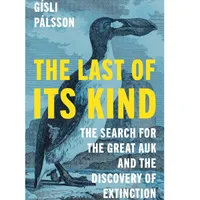
The Last of Its Kind: The Search for the Great Auk and the Discovery of Extinction Hardcover – $20.40 on Amazon
The great auk is one of the most tragic and documented examples of extinction. A flightless bird that bred primarily on the remote islands of the North Atlantic, the last of its kind were killed in Iceland in 1844. Gísli Pálsson draws on firsthand accounts from the Icelanders who hunted the last great auks to bring to life a bygone age of Victorian scientific exploration while offering vital insights into the extinction of species.

Alexander McNamara is the Editor-in-Chief at Live Science, and has more than 15 years’ experience in publishing at digital titles. In 2024 he was shortlisted for Editor of the Year at the Association of British Science Writers awards for his work at Live Science. He has previously worked at New Scientist and BBC Science Focus.