 Live Science Plus





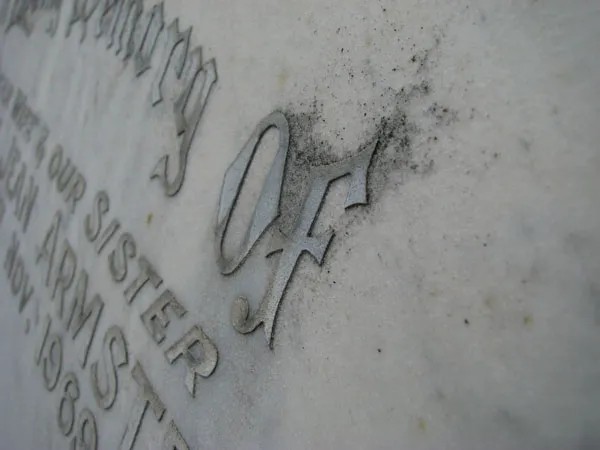
To a geologist, a gravestone can offer information other rocks can't. One project is using gravestones to better understand how the elements, particularly acid rain, are weathering rocks around the world, and how that's changed over time.
"It is a great place for us to collect scientific data because gravestones have got dates on them, it is not that we have a morbid fascination," said Gary Lewis, director of education and outreach for the Geological Society of America, which is in charge of the Gravestone Project.
Article continues below
"What we are trying to do is not just look at damage by acid rain, but we are trying to see how acid rain has changed over time," Lewis said.
The Gravestone Project recruits volunteers around the world to head into cemeteries where they use calipers to measure the width of a stone at five points along its sides and at its top. If a stone has lead letters on it, volunteers measure how much the stone has worn away from the lettering. Volunteers are asked to do this work respectfully.
Lewis and colleague Deirdre Dragovich of the University of Sydney have begun working through two years' worth of data collected so far, and they are still looking for more.
With the data they have so far, the researchers are looking at weathering rates over time and at potential links with atmospheric changes. Specifically, Lewis is interested in seeing if periods of increased rain in particular areas accelerated weathering rates, and if the arrival of the Industrial Revolution — and the increase in pollution that accompanied it — are reflected in increased gravestone weathering, and how the weathering rate has changed since the Industrial Revolution.
So far, they've seen that cemeteries in big cities seem to be weathering most rapidly, he said. This isn't a surprise since more acid rain-causing pollutants, particularly sulfur dioxide and nitrogen oxides, are released over urban areas.
Laura Guertin, an associate professor of earth science at Pennsylvania State University, already frequented the Cumberland Cemetery across the street from the Brandywine campus with her introductory geosciences students, when she began participating in the project in 2011.
At that cemetery and another in central Pennsylvania, Boalsburg Cemetery, she and her students have undertaken a wide range of projections, including comparing weathering rates of different types of stones (nearly all are granite or marble), and gleaning information about the history of the local community, such as how long people lived.
"At first they are a little creeped out," Guertin said. "I tell them, 'Don't worry, I will bring you all back with me.'"
Her students found a weathering pattern they didn't expect in certain areas within Cumberland Cemetery, where they found stones with the most wear on the sides of the top of the stone, rather than at the middle point.
"This is something I want my students to look into," she said.
You can follow LiveScience writer Wynne Parry on Twitter @Wynne_Parry. Follow LiveScience for the latest in science news and discoveries on Twitter @livescience and on Facebook.

