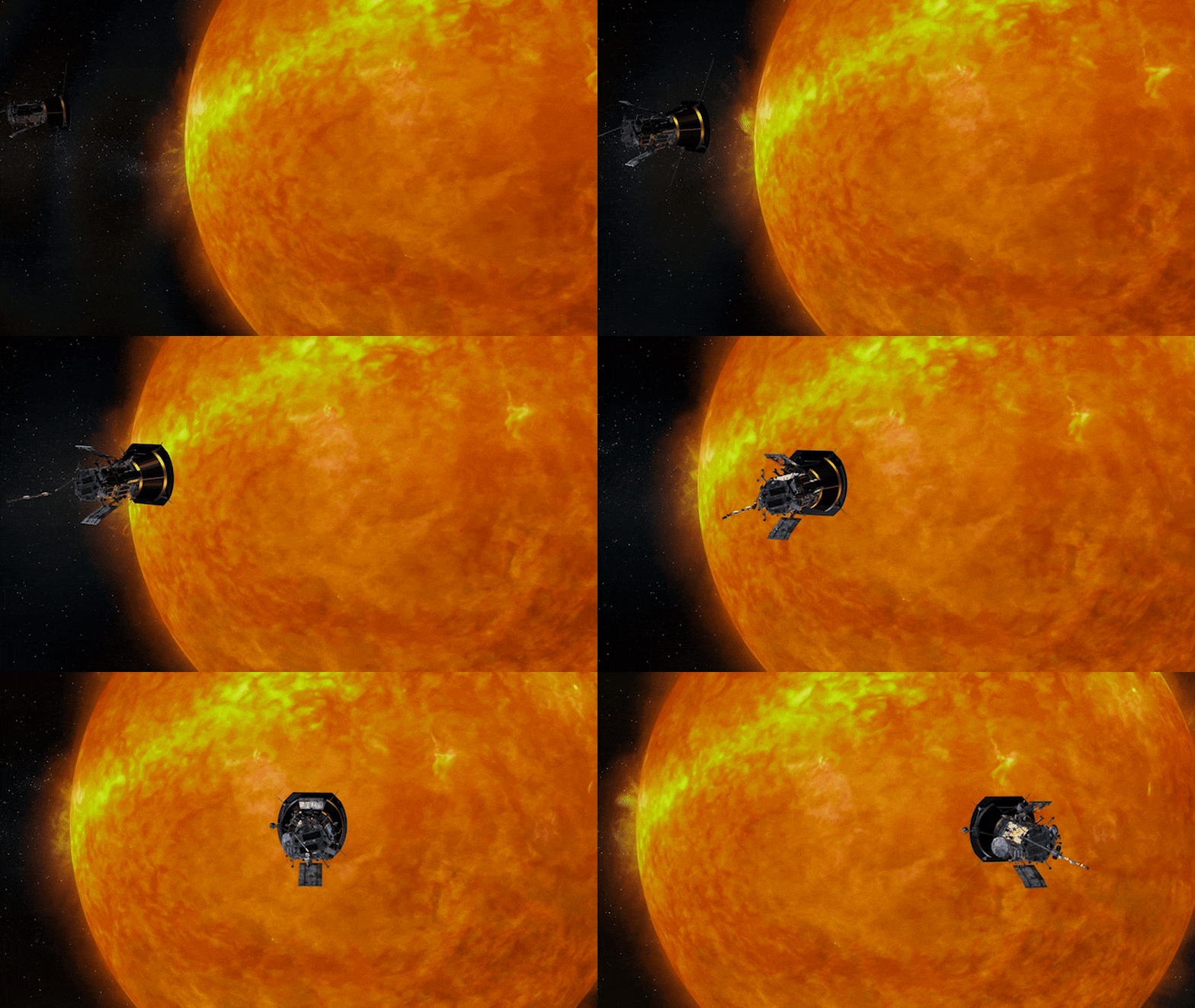
Artist’s concept of the Parker Solar Probe spacecraft approaching the sun. Launching in 2018, Parker Solar Probe will provide new data on solar activity and make critical contributions to our ability to forecast major space-weather events that impact life on Earth
A NASA probe has entered the sun's atmosphere and "touched" the blazing corona, in a first for solar science.
The Parker Solar Probe, which launched in 2018, conducted seven flybys of the sun before dipping into the corona during its eighth flyby on April 28, 2021. It made three trips into the sun's atmosphere, one of which lasted for 5 hours, mission scientists reported at a press briefing on Tuesday (Dec. 14) at the annual meeting of the American Geophysical Union (AGU).
In the upper reaches of the solar atmosphere, where temperatures average about 2 million degrees Fahrenheit (1 million degrees Celsius) — hotter than the light-emitting surface of the sun, which is only 10,000 F (5,500 C) — the spacecraft collected atmospheric particles in a special instrument called the Solar Probe Cup. By entering and sampling the sun's atmosphere, the Parker Solar Probe accomplished a scientific achievement akin to landing on the moon, scientists said at the briefing.
"Imagine yourself sitting on a beach and staring at the ocean wondering what lies beneath the surface. This is basically what scientists have been doing for decades, wondering what mysteries lie in the sun's corona," said Nicola Fox, Heliophysics Division Director of the Science Mission Directorate at NASA Headquarters. And just three years after Parker Solar Probe's launch, "we have finally arrived; humanity has touched the sun," Fox said at AGU, held this year in New Orleans and online.
Powerful solar winds made of streaming plasma and high-energy particles are born in the corona, but are mostly held back by the sun's magnetic fields, which also restrain bursts of plasma that spurt from the sun's surface. When solar winds exceed a certain speed and extend just past the sun's atmosphere, a location known as the Alfvén point, they can break free of their magnetic restraints. However, scientists didn't know where exactly that point was located.
Now, Parker Solar Probe has answered that question. Prior estimates based on remote images of the corona predicted that the Alfvén point would be found approximately 4.3 million to 8.6 million miles (6.9 million to 13.8 million kilometers) from the solar surface. Parker detected those conditions on April 28, at a distance of about 8.1 million miles (13 million km) above the sun, telling researchers that it had entered the sun's atmosphere for the first time.
Sign up for the Live Science daily newsletter now
Get the world’s most fascinating discoveries delivered straight to your inbox.
Solar winds and solar flares — swift eruptions of solar radiation — can affect electrical grids and disrupt communication networks on Earth, and the new data from the probe provides an unprecedented glimpse into these solar events, the researchers reported Dec. 14 in the journal Physical Review Letters.
"Our voyage is revealing a range of surprises as we venture into new places," Nour Raouafi, Project Scientist for NASA's Parker Solar Probe and a researcher at The Johns Hopkins Applied Physics Laboratory, said at the briefing. "The new physics we are learning about the immediate solar environment and the solar wind is mind-boggling."
A heat shield protects most of the probe from the sun, but the Solar Probe Cup had to extend beyond that protection in order to sample the corona. Engineers constructed the cup from materials with very high melting points — sapphire, tungsten, molybdenum and niobium — so that it could function under the extreme heat, according to representatives of the Harvard and Smithsonian Center for Astrophysics (CfA).
When the cup is exposed and making its measurements, "it's literally red-hot, with parts of the instrument at more than 1,800 degrees Fahrenheit [1,000 degrees Celsius], and glowing red-orange," CfA astrophysicist Anthony Case, the instrument scientist for the Solar Probe Cup, said in a statement.
Data collected by Parker Solar Probe in the corona reveals the sun as it's never been seen before, which will help scientists to better understand the roiling forces that generate the enormous quantities of energy powering our sun and other stars.
"This milestone is a first for any spacecraft, and marks one major step for Parker Solar Probe — and one giant leap for solar science," Fox said.
Mindy Weisberger is a science journalist and author of "Rise of the Zombie Bugs: The Surprising Science of Parasitic Mind-Control" (Hopkins Press). She formerly edited for Scholastic and was a channel editor and senior writer for Live Science. She has reported on general science, covering climate change, paleontology, biology and space. Mindy studied film at Columbia University; prior to LS, she produced, wrote and directed media for the American Museum of Natural History in NYC. Her videos about dinosaurs, astrophysics, biodiversity and evolution appear in museums and science centers worldwide, earning awards such as the CINE Golden Eagle and the Communicator Award of Excellence. Her writing has also appeared in Scientific American, The Washington Post, How It Works Magazine and CNN.