













First Image of a Memory Being Made

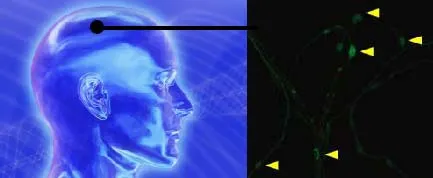
For the first time, an image of a memory being made at the cellular level has been captured by scientists.
The image shows that proteins are created at connections between brain cells when a long-term memory is formed. Neuroscientists had suspected as much, but hadn't been able to see it happening until now.
The experiment also revealed some surprising aspects of memory formation, which remains a somewhat mysterious process.
Kelsey Martin, a biochemist at the University of California, Los Angeles, and colleagues investigated memory formation in neurons from the sea slug Aplysia californica, a good model for brain cells in other organisms, including humans.
The researchers exposed the neurons to the chemical serotonin, which has been shown to stimulate memory formation (this discovery won Eric Kandel and collaborators the Nobel Prize in 2000). But in a new twist, the scientists devised a way to determine whether any new proteins were created when the memory was made.
The researchers used a fluorescent protein that can change from green to red when exposed to ultraviolet light. They flashed the cells with light, so that any proteins that already existed turned red. But when the scientists induced the cells to form memories, they saw new green proteins appear under the microscope.
"One distinction between short-term and long-term memory is this requirement for making new proteins," said co-investigator Wayne Sossin, a neuroscientist at McGill University in Montreal. "To make it last you do need protein synthesis."
Get the world’s most fascinating discoveries delivered straight to your inbox.
While the details aren't clear, scientists suspect that the new proteins help strengthen synapses, which are the connections between neurons.
"Most neuroscientists believe that memories occur when you change the strength of synaptic connections," Sossin told LiveScience. "In terms of what actually happens when you make a memory, there are a number of different models for how that increase happens."
One of the surprising revelations of the new study is that more regions of RNA, a protein-building instruction manual similar to DNA, are required to form the new proteins than previously thought.
The researchers also saw that both sides of the synapse (called the pre- and post- sides) are involved in forming the memory, rather than just one, as some experts thought.
"That was sort of surprising," Martin said in a phone interview. "What's really different here is being able to look at a memory being formed at the level of individual synapses."
Scientists still want to understand more about how our brains translate memories made on the go into long-term storage. Since synapses are connections between cells, experts think that fortifying these connections, or perhaps even making new ones, helps our minds associate different ideas and form memories of connected events.
- 5 Things You Must Never Forget
- Top 10 Mysteries of the Mind
- Memory News & Information
