













Bat Rabies Hops Species More Than Expected

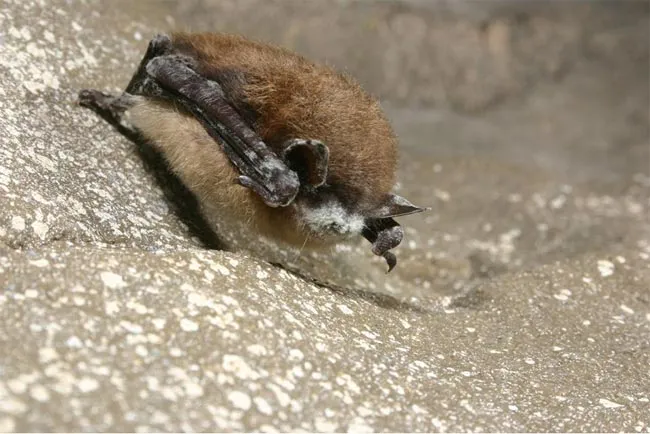
Bats and rabies are closely linked in the public imagination. Now, a new study finds that the spread of the disease between bat species depends heavily on evolutionary ties.
Rabies, a viral infection that causes brain inflammation and death, can easily pass between animals and humans. It's not the only virus with that talent: Outbreaks of SARS (spread through animals in Chinese food markets) and H1N1 flu (originating from pigs) illustrate the importance of animal diseases to human health. But figuring out when and why a virus will leap from one species to another is difficult.
"It's pretty hard to overstate the importance of cross-species transmission," said lead study researcher Daniel Streicker, a Ph.D. student at the University of Georgia's Odum School of Ecology. "It's also hard to overstate how little we know about it."
Bat brain bank
To find out more, Streicker and his colleagues looked to bats. Because rabies can easily pass between bats and humans, rabid bats are collected and tested by public health agencies in an attempt to control the disease spread. The result is a national bat "brain bank" full of virus-laden brain tissue ripe for genetic testing.
The researchers sequenced a segment of the genome from 372 rabies viruses found in 23 bat species over a 10-year period in the United States. By tracking the lineage of each virus, they were able to identify the species of origin of 360 rabies infections. In 43 cases, the researchers were able to definitively identify a jump from species to species.
The researchers then used computer simulations to model viral transmission. They found that a single rabid bat usually infects between zero and two individuals of other species. For every 73 within-species transmissions, one cross-species transmission occurs.
Get the world’s most fascinating discoveries delivered straight to your inbox.
"That was a bit of surprise, that it's happening as much as it is," said Sonia Altizer, an ecologist also at the Odum School of Ecology, who was not involved in the research. "When you think of all the dozens of bat species, and each species has between tens of thousands and tens of millions of individuals out there, the fact that one out of every 73 transmission events is between species is quite a lot."
The researchers were also surprised to find that overlapping ecological range ⎯ the places bats roost and forage ⎯ had less impact on risk of cross-species transmission than did evolutionary history. North American bat species diverged from one another into the variety we have today over a span of 60 million to 3 million years ago. That means some pairs of species are more closely related than others. While bats do have to come in contact for infection to occur, close evolutionary ties raised the risk of that infection, the study showed. Evolutionary similarity also improved the chances that the rabies virus would continue to spread through the new species instead of simply dying along with its host.
Rabies transmission
Those findings are important, Streicker said, because rabies is a so-called RNA virus that is very adept at mutating. The assumption has long been that these rapidly-evolving viruses should have no trouble thriving in new hosts. Streicker's results suggest that, at least in rabies, cross-species barriers do still exist.
One final surprise, Streicker said, was that rabies transmission rates were highest in solitary bats versus communal species. The finding suggests that rabies' trademark aggression might incite solitary bats to attack other bats while foraging.
"At least with solitary bats, that might be an important mechanism of transmission," Streicker said.
More research is needed to find out if the rabies findings generalize to other viruses and other species, Altizer said. Researchers also aren't yet sure how transmission patterns change when species are less closely related, as in bat-to-human infection. Another important question is what cellular or molecular barriers keep a virus from setting up shop in a new species.
"This really emphasizes how ecology and evolution are relevant for human health and for animal health," Altizer said. "We can't just study relationships between humans and their pathogens in a vacuum. We need to be aware of evolution in other animals and relationships to the environment."
- Top 10 Mysterious Diseases
- 10 Deadly Diseases That Hopped Across Species
- Top 10 Infectious Movies

Stephanie Pappas is a contributing writer for Live Science, covering topics ranging from geoscience to archaeology to the human brain and behavior. She was previously a senior writer for Live Science but is now a freelancer based in Denver, Colorado, and regularly contributes to Scientific American and The Monitor, the monthly magazine of the American Psychological Association. Stephanie received a bachelor's degree in psychology from the University of South Carolina and a graduate certificate in science communication from the University of California, Santa Cruz.