













Evolution, normally viewed as a slow, steady process, can occur in rapid fits and starts with one species splitting into several lineages in a relatively short period of time. Now scientists have identified two factors that influence these bursts of new species.
Called adaptive radiation, the relatively swift emergence of new species is known to occur in isolated ecosystems, such as remote islands, or following mass extinctions. But details about what drives this process have remained murky.
Two new studies, detailed in the March 22 issue of the journal Nature, suggest predator-prey relationships, as well as the timing and relative order of a species' arrival into a new environment, can greatly affect how rapidly this branching process occurs. Predation pressure
The studies involved microbes, in part because they can be easily manipulated in the lab and, with such short life cycles, they evolve quickly over time.
Justin Meyer and Rees Kassen of the University of Ottawa in Canada looked at the effects of a predator, a single-celled microbe called Tetrahymena thermophila [image], on the diversification of the soil bacterium Pseudomonas fluorescens [image].
They found that under some circumstances, the predators helped cull the bacteria population. This prevented overcrowding, which, in turn, reduced bacterial competition for food resources. With less interspecies competition, the bacteria were less inclined to spread out and fill new niches or experiment with new foods. Thus, predators appear to stifle speciation under some circumstances.
“There’s less need for prey to evolve into different types because the environment’s not saturated,” Meyer explained.
Get the world’s most fascinating discoveries delivered straight to your inbox.
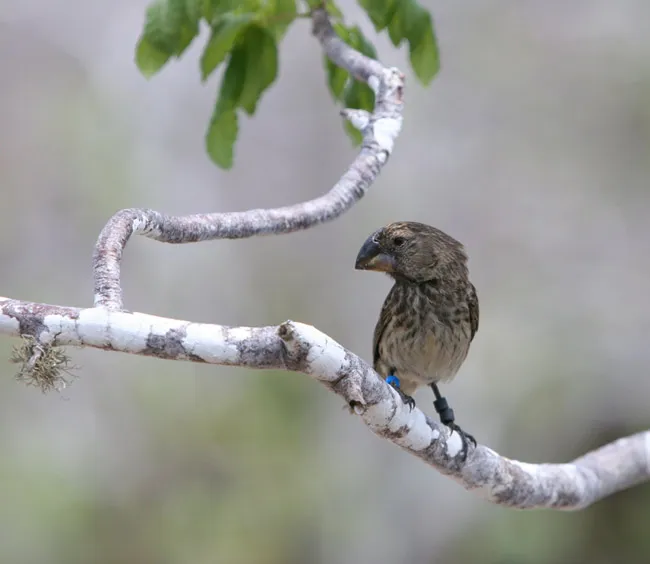
The findings suggest predation plays a prominent, yet often overlooked, role in the evolutionary histories of many species. It also helps explain why organisms that find their way to remote islands often undergo a speciation explosion and branch rapidly into different lineages. A classic example is Darwin’s finches in the Galapagos. Scientists think these 13 finches [image] evolved from a common ancestor that found its way to the islands about 3 million years ago.
On an island with plentiful resources, few competitors and no predators, the ancestral finch was in evolutionary paradise and diversified to fill available niches. The ancestral finch ate seeds and spent most of its time on the ground; today, the Galapagos finches eat insects, grubs, seeds, fruit and even blood. There’s even a finch that uses small twigs as tools.
The birds are named after Charles Darwin, who at age 26 visited the islands and collected the birds. The finches were one of the inspirations for Darwin’s theory of evolution by natural selection. Immigration history
Another study, by Tadashi Fukami at the University of Hawaii and colleagues, found that the order and timing of a species arrival into an isolated habitat can have a large influence on whether a species diversifies at all.
Also using P. fluorescens as a model, Fukami’s team showed that if two variants of the bacteria are introduced into an environment at different times, the first to arrive has a huge resource advantage.
“You can preempt resources like nutrients and oxygen, and by doing that, you can suppress others,” Fukami told LiveScience.
The team also showed that under some circumstances, the opposite can also be true, and it actually pays to arrive last. For example, if species A and B are already living in an environment and busy competing with each other, a third species C could sneak in and establish itself while the other two species duke it out.
Rosemary Gillespie, a biologist at the University of California, Berkeley who was not involved in the studies, says the results could help explain some findings that have puzzled biologists. One ecological conundrum involves the existence of empty niches that never get filled by species.
The results of Fukami’s team “raise the possibility that inconsistencies are partly due to immigration history,” Gillespie wrote in an accompanying Nature commentary article.
- Gallery: Darwin on Display
- Behind the Controversy: How Evolution Works
- Intelligent Design: An Ambiguous Assault on Evolution
- A No Brainer: Predators Prefer Dimwitted Prey