













Killer Whales Set Traps for Gullible Gulls
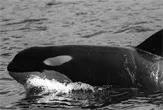
Killer whales are more conniving than scientists ever thought.
They set traps for their prey, then share their hunting tricks with friends.
Killer whales hunt like wolves, encircling prey before attacking. In the stomachs of orcas, scientists have found the remains of seals, penguins, polar bears and even a moose.
Now researchers at Marineland in Ontario, Canada have observed a four-year-old killer whale setting a trap for seagulls by spitting fish onto the water's surface as bait.
The whale would sink below the water and wait for an unsuspecting gull to come down for a meal. Once the bird took the bait, the whale would lunge at it with open jaws. The whale, pleased with the results, set up the trap over and over again.
The trap worked so well that after a few months the whale's younger brother gave it a try.
"It looked like one was watching while the other tried," said Michael Noonan, a professor of animal behavior at Canisius College.
Get the world’s most fascinating discoveries delivered straight to your inbox.
Next, his mother adopted the trick, and pretty soon all the orcas at the facility were hooked.
"It was once believed that most animal behavior, from the food they ate to the places they slept, was based on instinct," Noonan said. "This new discovery supports the growing view that animals like killer whales are very prone to learning by imitation, and that they are 'cultural' in nature."