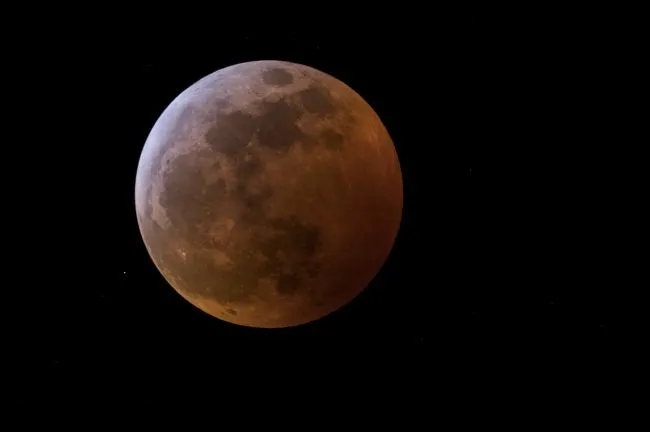
Tomorrow (July 16), the 50th anniversary of the launch of Apollo 11 to land astronauts on the moon and two weeks after the moon totally eclipsed the sun, it will be the moon's turn to undergo an eclipse of its own. The full moon, in Sagittarius, will pass partway through the southern part of the Earth's shadow resulting in a partial lunar eclipse.
This event favors the Eastern Hemisphere, known colloquially as the "Old World": Africa, Europe and western Asia. Most of South America will see the moon rise already within the Earth's shadow. Conversely, for central and eastern Asia and Australia, the eclipse will still be in progress when the moon sets during the dawn hours of July 17.
Unfortunately, North America will be completely shut out; the eclipse occurs during the daytime with the moon below the horizon.
This map shows the region of visibility for the partial lunar eclipse of July 16, 2019. Observers in South America, Europe, Africa, Asia and Australia will be able to see the eclipse, weather permitting.
(Image credit: NASA/Fred Espenak)
In Coordinated Universal Time (UTC), the moon will enter penumbra (the weaker part of Earth's shadow) at 18:43 and umbra (the darker part of Earth's shadow) at 20:01. The midpoint of the eclipse will come at 21:30. The moon will leave umbra at 22:59 and leave penumbra at 00:17 on July 17, marking the end of the event.
The magnitude of the eclipse, which refers to the maximum percent of the moon's diameter immersed within Earth's umbral shadow, will be 65%. This deepest stage of the eclipse will take place at 21:30 UTC, when the dark red-brown umbra will cover the northern 65% of the moon's diameter. The moon will appear directly overhead, or very nearly so, from the Mozambique Channel.
This NASA chart shows both the map of visibility and times of major events (in UT) of the partial lunar eclipse of July 16, 2019.
(Image credit: NASA/Fred Espenak)
The penumbral phases of the eclipse occur when the moon is only within the penumbra, or the pale outer fringe of Earth's shadow. The weak, pale-gray penumbral shading is detectable only within about 25 minutes of the partial eclipse's beginning or end, depending on sky conditions and how carefully you look. A faint shading or smudge on the moon's disk should become evident for most viewers around 19:35 UTC, and the last vestige of any faint tarnishing should disappear around 23:25 UTC.
Sign up for the Live Science daily newsletter now
Get the world’s most fascinating discoveries delivered straight to your inbox.
This will be the moon's last interaction with Earth's umbra for a while. During the next four lunar eclipses — all during the year 2020 — the moon will pass only through Earth's penumbra. We'll have to wait until the morning of May 26, 2021, when the central and western United States will be treated to a total lunar eclipse, although totality will be relatively short, lasting less than 18 minutes. Then, on the morning of Nov. 19, 2021, North Americans will be treated to an eclipse covering 98% of the moon's diameter.
Finally, on the night of May 15-16, 2022, an unusually long total lunar eclipse will be visible over most of the Americas. Totality will last almost 1.5 hours. Mark your calendars.
Joe Rao is a television meteorologist in the Hudson Valley, appearing weeknights on News 12 Westchester. He has also been an assiduous amateur astronomer for over 45 years, with a particular interest in comets, meteor showers and eclipses. He has co-led two eclipse expeditions and has served as on-board meteorologist for three eclipse cruises. He is also a contributing editor for Sky & Telescope and writes a monthly astronomy column for Natural History magazine as well as supplying astronomical data to the Farmers' Almanac. Since 1986 he has served as an Associate and Guest Lecturer at New York's Hayden Planetarium. In 2009, the Northeast Region of the Astronomical League bestowed upon him the prestigious Walter Scott Houston Award for more than four decades of promoting astronomy to the general public.