















Alien Life Might 'Think' More Like an Octopus Than a Human

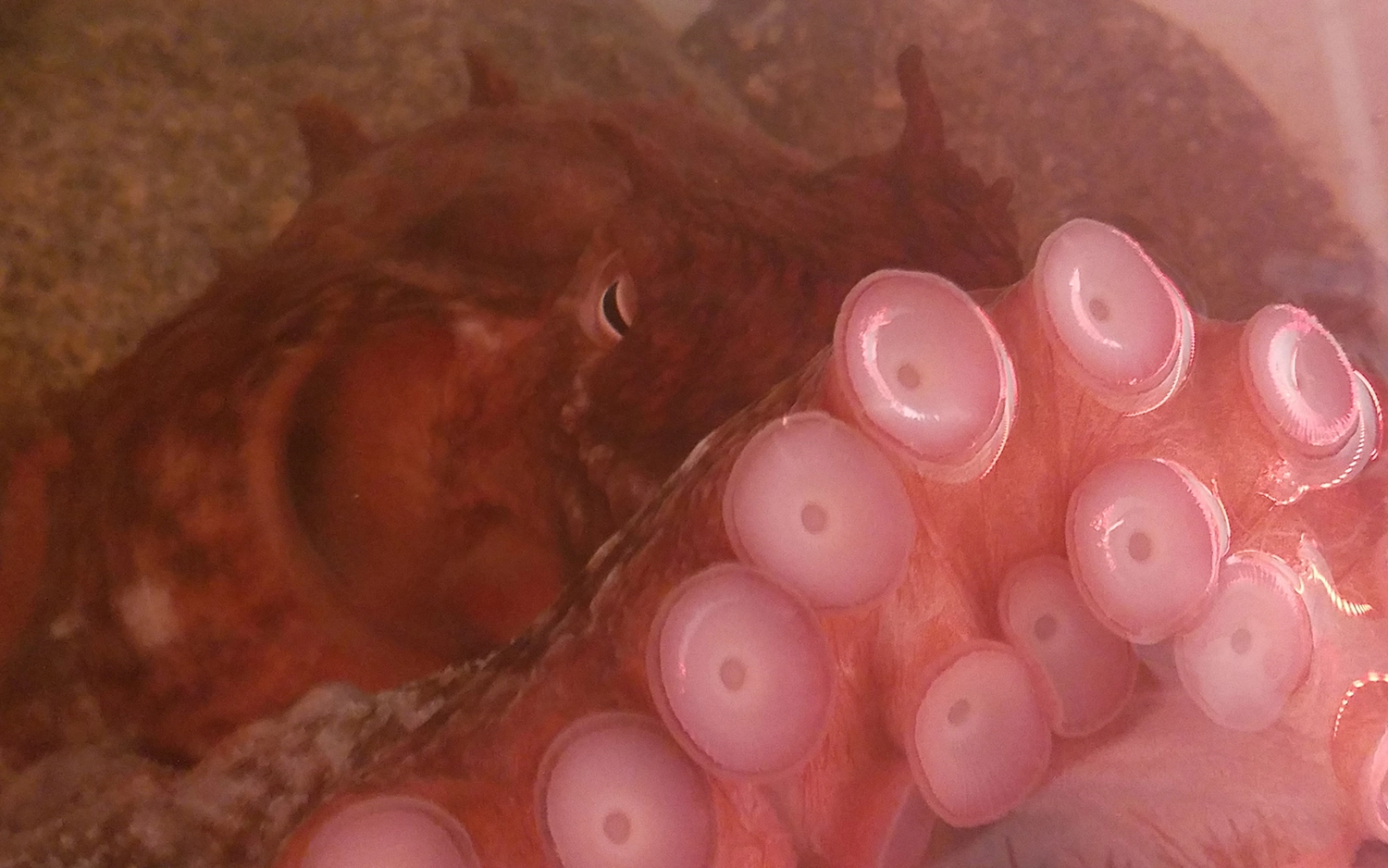
When an octopus coils one of its flexible arms around a rock or a bit of food, it's not because the animal's brain said, "Pick that up." Rather, the arm decides for itself what it's going to do next. For a person, that would be like having one's big toe call the shots about where they're going to walk.
But a cephalopod's nervous system isn't wired like a human's — or like the systems found in any other vertebrates, for that matter, where a central brain broadcasts marching orders to the rest of the body. Instead, octopus limbs are studded with concentrations of neurons called ganglia; these "arm brains" can therefore operate independently of the central brain.
In fact, scientists who recently visualized progressive movement in octopus arms discovered that the animal's central brain is hardly involved at all; they presented their findings June 26 at the 2019 Astrobiology Science Conference. [8 Crazy Facts About Octopuses]
The researchers used a camera and behavioral-tracking software to model how an octopus perceives and then processes information about its environment using its arms, Dominic Sivitilli, a graduate student in behavioral neuroscience and astrobiology at the University of Washington in Seattle, explained during the presentation.
"What we're looking at, more than what's been looked at in the past, is how sensory information is being integrated in this network while the animal is making complicated decisions," Sivitilli said in a statement.
An octopus's arm movement begins far away from the brain, triggered by sensors in a groping arm sucker feeling around on the seafloor or in an aquarium. Each sucker contains tens of thousands of chemical and mechanical receptors; to put that into perspective, a human fingertip holds just a few hundred mechanical receptors, Sivitilli said.
When an octopus touches something interesting, the "brain" in its arms processes the input and moves the signal along, telling the arm what to do next. Signals generated by one sucker are passed to its closest neighbor, activating arm muscles and generating a sweeping wave of motion that travels up the arm toward the body, the researchers discovered. While the arms are actively engaging with the environment — and with each other — the signal that reaches the animal's central brain is "highly abstracted" and not directly involved with arm interactions, Sivitilli explained.
Get the world’s most fascinating discoveries delivered straight to your inbox.
Essentially, octopuses "outsource" computation about how to move their bodies, assigning those actions to local controls — ganglia — in each arm, rather than relying on the central brain to tell the arms what to do, Sivitilli said in the presentation.
"In a way, the octopus has sent its mind out into the environment to meet it halfway," he added.
But wait, you might be thinking — why are scientists talking about octopuses at an astrobiology conference? What does this have to do with extraterrestrial life? (And no, it's not because octopuses are really space aliens, as another group of researchers claimed in 2018.)
Octopuses are thought to be highly intelligent, yet their workarounds for perceiving and interacting with the world around them differ dramatically from techniques that evolved in intelligent vertebrates. Octopus cognition could therefore serve as an important alternative model for understanding intelligence, and it could prepare experts for recognizing unusual expressions of intelligent life that originated on other worlds, Sivitilli said in the statement.
"It gives us an understanding as to the diversity of cognition in the world," Sivitilli said. "And perhaps the universe."
- Photos: Ghostly Dumbo Octopus Dances In the Deep Sea
- In Photos: Amazing 'Octomom' Protects Eggs for 4.5 Years
- Octlantis: See Photos of Tight-Knit Gloomy Octopus Communities
Originally published on Live Science.

Mindy Weisberger is a science journalist and author of "Rise of the Zombie Bugs: The Surprising Science of Parasitic Mind-Control" (Hopkins Press). She formerly edited for Scholastic and was a channel editor and senior writer for Live Science. She has reported on general science, covering climate change, paleontology, biology and space. Mindy studied film at Columbia University; prior to LS, she produced, wrote and directed media for the American Museum of Natural History in NYC. Her videos about dinosaurs, astrophysics, biodiversity and evolution appear in museums and science centers worldwide, earning awards such as the CINE Golden Eagle and the Communicator Award of Excellence. Her writing has also appeared in Scientific American, The Washington Post, How It Works Magazine and CNN.