













Scientists Find Scurvy in Mouth of Long-Dead, Failed Crusader King

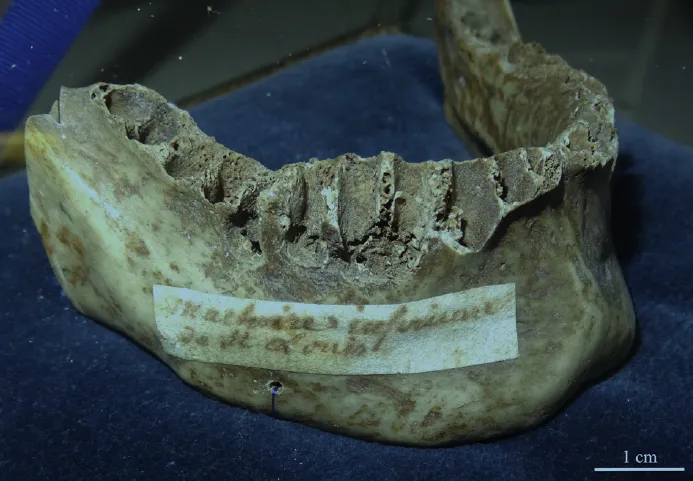
One of the last crusader kings had scurvy when he died, a new forensic analysis finds — contradicting old narratives that he died of plague or dysentery.
The new find comes from an old jawbone that was buried in Notre Dame Cathedral. It was said to belong to Louis IX, a king of France who died besieging Tunis during the Eighth Crusade in 1270 and was later canonized as St. Louis. They found forensic evidence that the bone did indeed come from St. Louis, and that he had a severe case of scurvy when he died. The results of their examinations were made available online June 8 in the Journal of Stomatology, Oral and Maxillofacial Surgery.
Scurvy is a disease that results from vitamin C deficiency. A healthy person gets enough vitamin C to ward it off. But Louis, who seems to have eaten mostly fish during the campaign, may not have eaten the local foods in Tunis that contained the nutrient. Scurvy causes gum disease, loss of teeth, anemia and weakness, among other symptoms. [Photos: Medieval Skeletons Unearthed Near Saint's Tomb in England]
The researchers quoted an account by Jean de Joinville, the medieval chronicler who recorded a history of the crusade, for evidence that scurvy was common in Louis' army.
"Our army suffered from gum necrosis (dead gums)," Joinville wrote, "and the barbers had to cut the necrotizing tissue in order to allow the men to chew the meat and swallow. And it was a pity to hear the soldiers shouting and crying like women in labor when their gums were cut."
To prove that the jawbone indeed came from Louis IX, the researchers first visually inspected it and showed that it had the right shape for a jaw of a 56-year-old man. (Louis IX was 56 years old when he died.) Then they compared it to existing sculptures in the cathedral of the dead king's face, and found they closely matched up. Finally, the team performed radiocarbon dating on the bone to measure the amount of carbon with eight attached neutrons (a radioactive variety) in the bone.
Radioactive carbon decays at a constant rate and bodies stop absorbing new carbon from the environment at death, so carbon 14 levels are used to determine a bone sample’s age. Intriguingly, the carbon in the jawbone seemed to come from a man who died between the years 1030 and 1220. That would be too early to be Louis, they wrote, except that Louis seems to have lived mostly or entirely on fish. And the ocean has less carbon 14, so ocean creatures are known have somewhat less of this radioactive carbon in their bodies than land-based creatures. Thus it seems, the researchers wrote, that Louis simply ate so much fish that it made his bones seem older.
Get the world’s most fascinating discoveries delivered straight to your inbox.
The researchers found evidence of severe scurvy in the jaw, but that doesn't mean the scurvy killed him, the researchers said. Scurvy can weaken the immune system, allowing other infections to take root, they pointed out. The next step, they said, is to study the king's guts (which were boiled in wine and spices to preserve them, and stored elsewhere in Europe) and figure out what parasites were present.
- The 25 Most Mysterious Archaeological Finds on Earth
- 25 Grisly Archaeological Discoveries
- Postmortem Photos: King Richard III's Battle Injuries
Originally published on Live Science.
