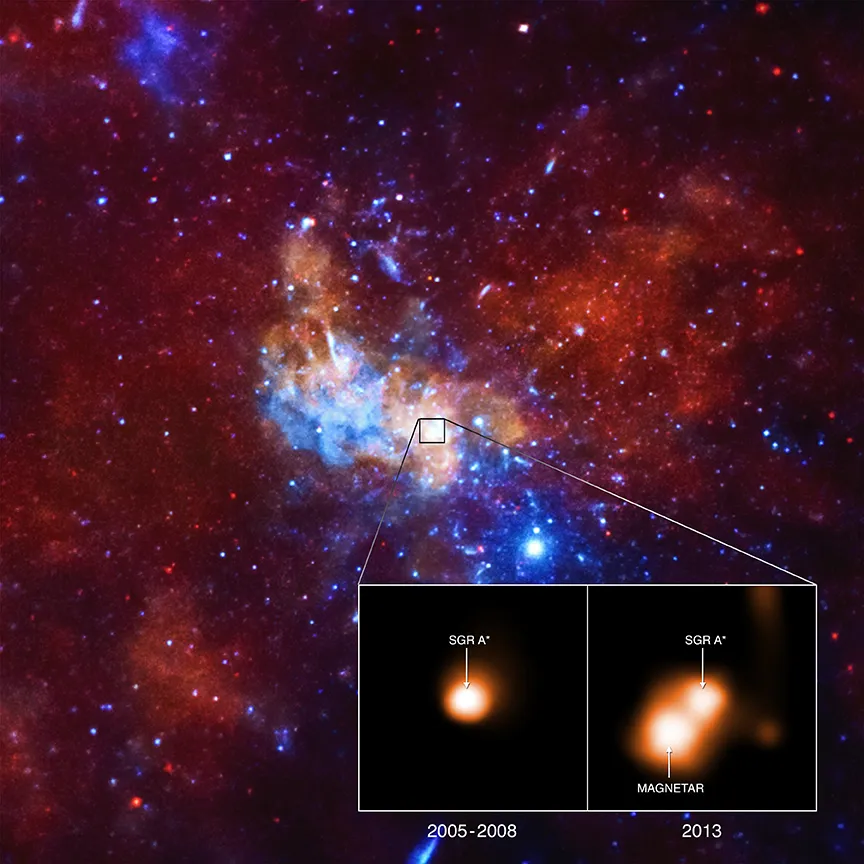
There's a bright magnetar photobombing the supermassive black hole at the center of the Milky Way, frustrating astronomers' efforts to study the black hole — called Sagittarius A* — using X-ray telescopes.
SagA* is the nearest known supermassive black hole to Earth. And while it's far smaller, quieter and dimmer than the recently imaged black hole at the center of the galaxy Messier 87, it still represents one of the best opportunities astronomers have for understanding how black holes behave and interact with their surrounding environments. But back in 2013, a magnetar — an ultradense star (also called a neutron star) wrapped in powerful magnetic fields — between SagA* and Earth lit up, and ever since has been messing with efforts to observe the black hole using X-ray telescopes.
"We think of this as maybe a shattering of the neutron star surface, or some really violent event on the neutron star that causes it to get very, very bright and then fade slowly over time," said Daryl Haggard, a physicist at McGill University in Montreal who studies SagA* and the galactic center. [3 Huge Questions the Black Hole Image Didn't Answer]
Magnetars are tiny objects, part of a class of stars often comparable in size to Manhattan island. Before the little star lit up, it didn't give any sign that it was even there.
In 2013, that changed. At the time, Haggard was part of a team observing SagA* using X-ray telescope data to see how the black hole would interact with G2 — a big, gassy object that was due to pass very close to the black hole. Black holes don't emit any light, but the hot gas orbiting just outside their event hoizons does. SagA*'s surrounding cloud usually glows only faintly, but researchers hoped that as G2 crashed through it the result would be some interesting X-ray flashes.
Then, on April 24 of 2013, a cascade of surprising data started coming in from their telescopes. The first telescope to notice the sudden change was Swift, an orbital NASA telescope.
"We were watching the supermassive black hole, trying to pick up a little bit of a signature in the X-ray wavelengths from this interaction, and then BANG, the magnetar went off," she told Live Science, clapping her hands together for emphasis.
Sign up for the Live Science daily newsletter now
Get the world’s most fascinating discoveries delivered straight to your inbox.
There was a bright flash of X-ray light. At first, astronomers thought they were seeing some new and unprecedented behavior from the black hole, possibly a massive flare, Haggard said. Most X-ray observatories don't have the resolution to distinguish between two objects, especially with the magnetar flaring that brightly.
The two objects are quite far apart in physical space, about 2 trillion miles (3.2 trillion kilometers), or a third of a light-year. Telescopes regularly see other, closer stars around the black hole as distinct objects. But it happens to be that SagA* and the magnetar (named SGR 1745-2900) are angled such that from the perspective of Earth they're nearly on top of one another, just 2.4 arcseconds apart in the sky. (The whole sky is 1,296,000 arcseconds around.)
Most X-ray observatories see them as pretty much a single object, Haggard said.
An image from the Swift X-Ray observatory shows the two X-ray sources look like a single object.
(Image credit: NASA)
"Initially, the big excitement was, 'Holy cow, SagA* just went nuts!' It would have been the brightest flare we'd ever seen from the supermassive black hole," she said, referring to the flare of X-ray light.
But on April 26, 2013, NuSTAR, another NASA orbital X-ray telescope, picked up something funny in the bright flare: a sort of ticking, pulsing quality to the light, with peaks every 3.76 seconds. That's not the sort of behavior they would expect from the gas clouds around a black hole, even in its most excited state, Haggard said. [9 Ideas About Black Holes That Will Blow Your Mind]
Three days later, on April 29, the Chandra X-Ray Observatory, the sharpest telescope of its kind in space, resolved the image well enough to see that there were in fact two X-ray sources: the bright, flickering new light, and the comparatively dimmer glow of the gas around a quiescent SagA*.
A close-up from Chandra (right) shows that when SagA* was quiescent in 2013, it was barely visible as a few extra photons on the upper right side of the magnetar. When the black hole flared, as it does periodically, it was more visible (left).
(Image credit: Chandra X-Ray Observatory)
As a team of observers reported in The Astrophysical Journal in May of that year, that pulsing was characteristic of a bright point on a rapidly spinning star pointing toward and away from Earth like a sped-up lighthouse. Astrophysicists realized they were seeing a magnetar.
"Depending on your perspective, it was either a complete pain or a completely awesome new discovery," Haggard said.
Over time, the magnetar's glow has faded, albeit more slowly than is typical. These days, Haggard said, it's about equal in X-ray brightness to the glow of the black hole's surrounding hot gas, allowing Chandra to more easily distinguish the two. Still, she said, they look a bit like the two headlights of a car that are so far away they've started to blend into one. It's not easy for even Chandra to tell which X-ray photons are coming from the hot gas around the black hole, and which from the magnetar.
A 2014 image shows how the slowly-dimming magnetar is allowing SagA* to peek out again.
(Image credit: Chandra X-Ray Observatory)
For observers of the galactic center, Haggard said, this sort of issue is typical. There's such a dense, bright cloud of hot material in the area, she said, that any observation requires carefully sorting out good data from junk. The magnetar has become just one more frustration for SagA* observers to deal with.
Rafi joined Live Science in 2017. He has a bachelor's degree in journalism from Northwestern University’s Medill School of journalism. You can find his past science reporting at Inverse, Business Insider and Popular Science, and his past photojournalism on the Flash90 wire service and in the pages of The Courier Post of southern New Jersey.