Ripples in Space-Time Could Help Solve Cosmic Mystery of How Fast Universe Is Expanding

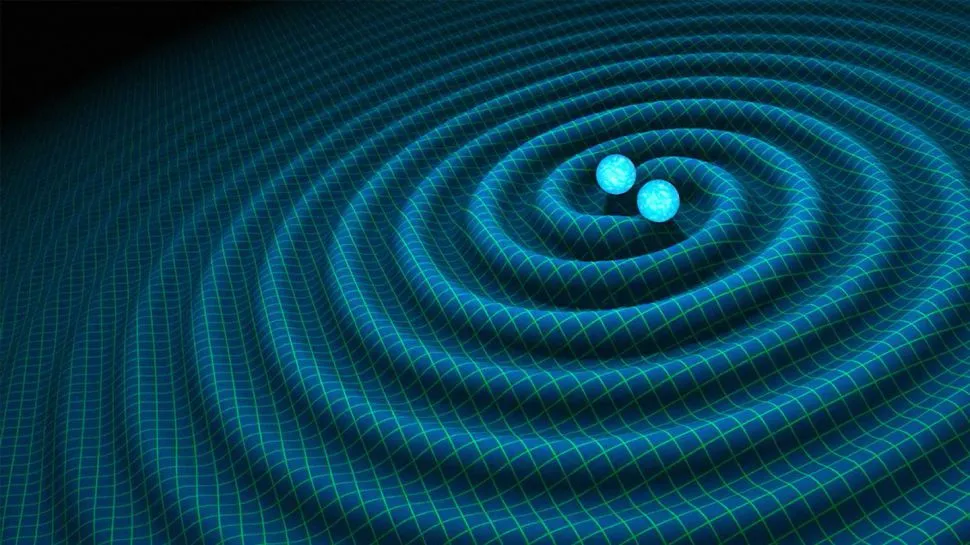
Analyzing ripples in the fabric of space and time created by pairs of dead stars may soon solve a cosmic mystery surrounding how quickly the universe is expanding — if scientists are lucky.
That's the verdict of a new study, which may also shed light on the ultimate fate of the universe, the researchers who worked on it have said.
The cosmos has continued expanding since its birth about 13.8 billion years ago. By measuring the present rate of the universe's expansion, known as the Hubble constant, scientists can deduce the age of the cosmos and details of its current state. They can even use the number to try to learn the fate of the universe, such as whether it will expand forever, collapse upon itself or rip apart completely.
Related: In Images: The Amazing Discovery of a Neutron-Star Crash, Gravitational Waves & More
However, this pair of techniques has yielded two different results for the value of the Hubble constant. Data from the cosmic microwave background suggests the universe is currently expanding at a rate of about 41.6 miles (67 kilometers) per second per 3.26 million light-years, while data from supernovas and Cepheids in the nearby universe suggests a rate of about 45.3 miles (73 km) per second per 3.26 million light-years.
This discrepancy suggests that the standard cosmological model — scientists' understanding of the universe's structure and history— could be wrong. Resolving this debate, known as the Hubble constant conflict, could shed light on the evolution and ultimate fate of the cosmos.
In the new study, physicists suggest that future data from the ripples in the fabric of space and time known as gravitational waves might help break this deadlock. "The Hubble constant conflict — the biggest hint we have that our model of the universe is incomplete — is resolvable in five to 10 years," lead study author Stephen Feeney, an astrophysicist at the Flatiron Institute in New York, told Space.com.
Get the world’s most fascinating discoveries delivered straight to your inbox.
According to Einstein's theory of general relativity, gravity results from how mass distorts space-time. When any object with mass moves, it should produce gravitational waves that zip at the speed of light, stretching and squeezing space-time along the way.
Gravitational waves are extraordinarily weak, and it was only in 2016 that scientists detected the first direct evidence of them. In 2017, scientists also detected gravitational waves from colliding neutron stars, remnants of stars that perished in catastrophic explosions known as supernovas. If a star's remains are not massive enough to collapse to become a black holes, they will instead end up as a neutron star, so named because its gravitational pull is strong enough to crush protons together with electrons to form neutrons.
Unlike black holes, neutron stars emit visible light, and so do their collisions. The gravitational waves from these mergers, dubbed "standard sirens," will help scientists pinpoint their distance from Earth, while the light from these collisions will help determine the speed at which they were moving relative to Earth. Researchers can then use both these sets of data to calculate the Hubble constant. According to Feeney and his colleagues, analyzing crashes between about 50 pairs of neutron stars in the next five to 10 years may yield enough data to determine the best measurement yet of the Hubble constant.
However, that estimate depends on how often neutron-star collisions occur. "There is considerable uncertainty in the rate of neutron star mergers — we have, after all, only seen one to date," Feeney said. "If we were very lucky to see that one, and mergers are actually much rarer than we think, then observing the number of mergers needed to explain the Hubble constant conflict could take longer than we stated in our work."
Gravitational waves may end up supporting one value for the Hubble constant over the other, but they may also determine a new third value for the Hubble constant, Feeney said. If this happens, it might lead to new insights regarding the behavior of supernovas, Cepheids or neutron stars, he added.
The scientists detailed their findings online Feb. 14 in the journal Physical Review Letters.
Follow Charles Q. Choi on Twitter @cqchoi. Follow us on Twitter @Spacedotcom and on Facebook.