













Fish Fear Their Own Reflections

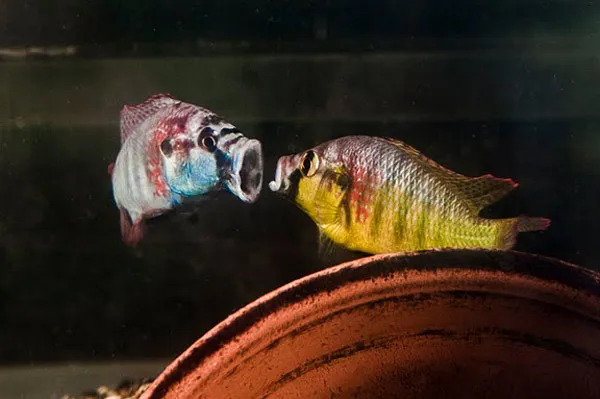
Looking at themselves in a mirror is enough to scare some fish, a new study finds.
Fish looking at a mirror showed increased brain activity in regions linked to fear than fish faced with an actual fish separated by glass, the study showed. However, in both instances the fish responded the same physically, engaging in a routine of combative gestures to try to fight the other fish – be it a reflection or an actual opponent.
"It seems like something they don't understand," said Julie Desjardins, researcher and post-doctoral biologist at Stanford University. "I think this stimulus is just so far outside their realm of experience that it results in this somewhat emotional response."
Desjardins and Stanford biologist Russell Fernald arranged 20 minute-long sparring sessions for male African cichlids, a freshwater territorial fish. A clear wall across the middle of the tank kept the combatants apart when two fish were pitted against each other, so there was never any actual fish-to-fish contact. In some instances, the clear wall was replaced with a mirror.
The fish invariably tried to fight with their foe – real or reflected – and their behavior during the dust-ups appeared consistent whether they were mirror-boxing or not.
Then, scientists tested blood samples for testosterone and other aggression-inducing hormones; the scientists also dissected each fish's brain, particularly the amygdala, the brain region tied to fear and fear conditioning. All fish showed high levels of testosterone, but only the fish that fought with their reflection showed high activity in the amygdala.
The anomaly suggests that lower vertebrates can make subtle discriminations not previously thought possible, the scientists said in a statement. Despite the fact that human amygdalae are significantly more elaborate than those of fish, frogs, lizards, and birds, they do share some of their complex features with these animals.
Get the world’s most fascinating discoveries delivered straight to your inbox.
Desjardins speculated that the fear or vexation was due to the unfamiliarity of the encounter:
"In normal fights, [the fish] bite at each other, one after the other, and will do all kinds of movements and posturing, but it is always slightly off or even alternating in timing. But when you are fighting with a mirror, your opponent is perfectly in time. So the subject fish really is not seeing any sort of reciprocal response from their opponent."
Calling the amygdala activity "surprising" and "pretty exciting," Desjardins said that given the comparable physical reactions and hormone levels, she never expected the brain to show a different response. Even researchers who exclusively study the cognitive capacities of non-mammalian animals rarely look at the brain, she pointed out, instead favoring hormones and behavior.
"But I think it certainly indicates that there is more going on cognitively than people have long assumed in most lower invertebrates," Desjardins said.
Perhaps the minds of fish have more in common with humans than expected. "Like when you are a little kid and someone keeps repeating back to you what you have just said, that quickly becomes irritating and frustrating," she said. "If I was going to make that giant leap between humans and fish, it could be similar."
- How Ambiguity Messes With Our Brains
- Image Gallery: Freaky Fish
- Amazing Animal Abilities
