













The Rubber Ducky Comet Blasted a Magnetic Path Through Space

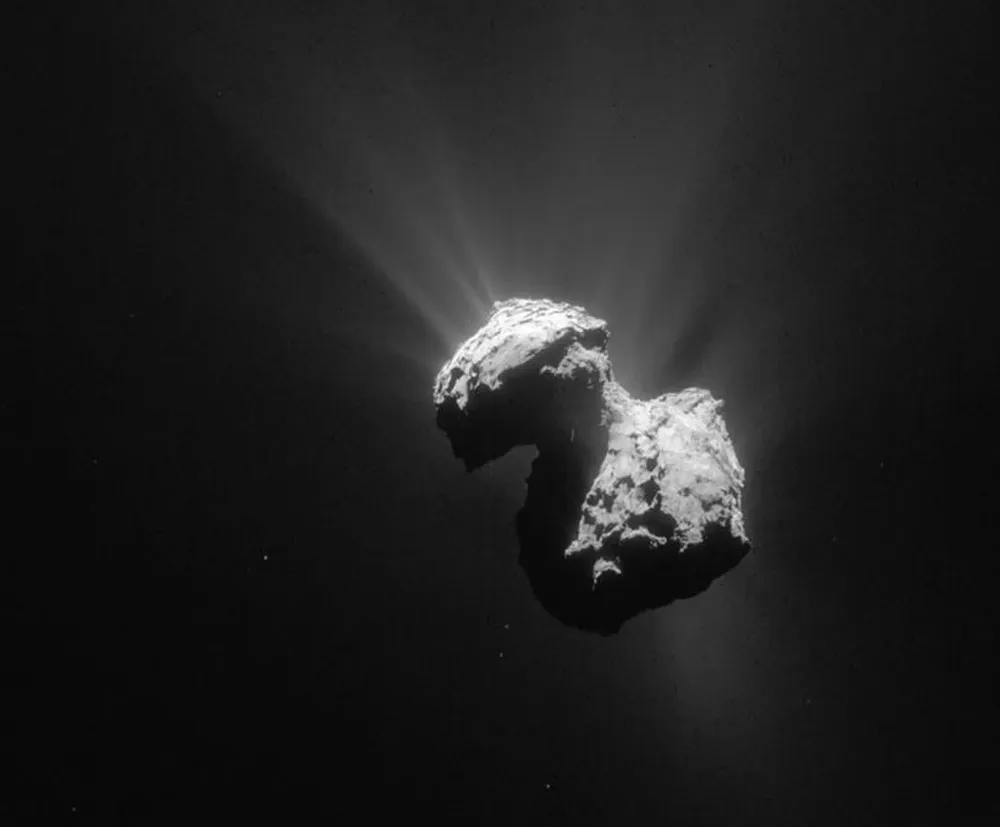
Rosetta's comet sent a magnetic shock wave screaming out in front of it, blazing a trail through the stellar wind. And scientists just found it.
Astrophysicists had been looking for evidence of such a wave, called a bow shock, around Comet 67p, the "rubber ducky" comet that the European Space Agency (ESA) probe Rosetta visited in 2016. Other comets, like Halley's Comet, have bow shocks, after all, so why not 67p?
A bow shock is created at the boundary between a comet's magnetic field and the inrushing stellar wind and other energized particles in space. But when researchers sifted through data from the period when Rosetta orbited 67p, Rosetta initially seemed not to have found a bow shock around its comet.
Now, in a paper published Nov. 6 in the journal Astronomy & Astrophysics, researchers report that Comet 67p did have a bow shock after all. It was just a faint, asymmetrical, baby bow shock that moved in unexpected ways, making it initially hard to spot in data Rosetta sent home. [Rosetta Probe Gets Rare Close-Up of Comet Eruption (Video)]
"We looked for a classical bow shock in the kind of area we'd expect to find one, far away from the comet's nucleus, but didn't find any, so we originally reached the conclusion that Rosetta had failed to spot any kind of shock," Herbert Gunell of the Royal Belgian Institute for Space Aeronomy and Umeå University in Sweden, a co-author on the paper, said in a statement.
But a more-careful analysis of the data revealed that Rosetta passed through a magnetically excited region during two periods, and the electrons and protons surrounding it it reacted to the boundary.
The first period occurred just as the comet began its closest approach to the sun, and the second occurred as the comet moved away from the sun.
Get the world’s most fascinating discoveries delivered straight to your inbox.
This means that "Rosetta observed a cometary bow shock in its infancy, a stage in its development not previously accessible [to astronomers]," the researchers wrote in the study.
After that point, as 67p neared the sun, the bow shock moved farther away from the comet, past the zone of Rosetta's orbit. But Rosetta saw sights never observed before: a bow shock flickering to life and its last moments before it died.
- 9 Strange, Scientific Excuses for Why Humans Haven't Found Aliens ...
- 7 Things Most Often Mistaken for UFOs
- Spooky! Top 10 Unexplained Phenomena
Originally published on Live Science.
