













An 18-Foot Fugitive Python Is on the Loose in Poland

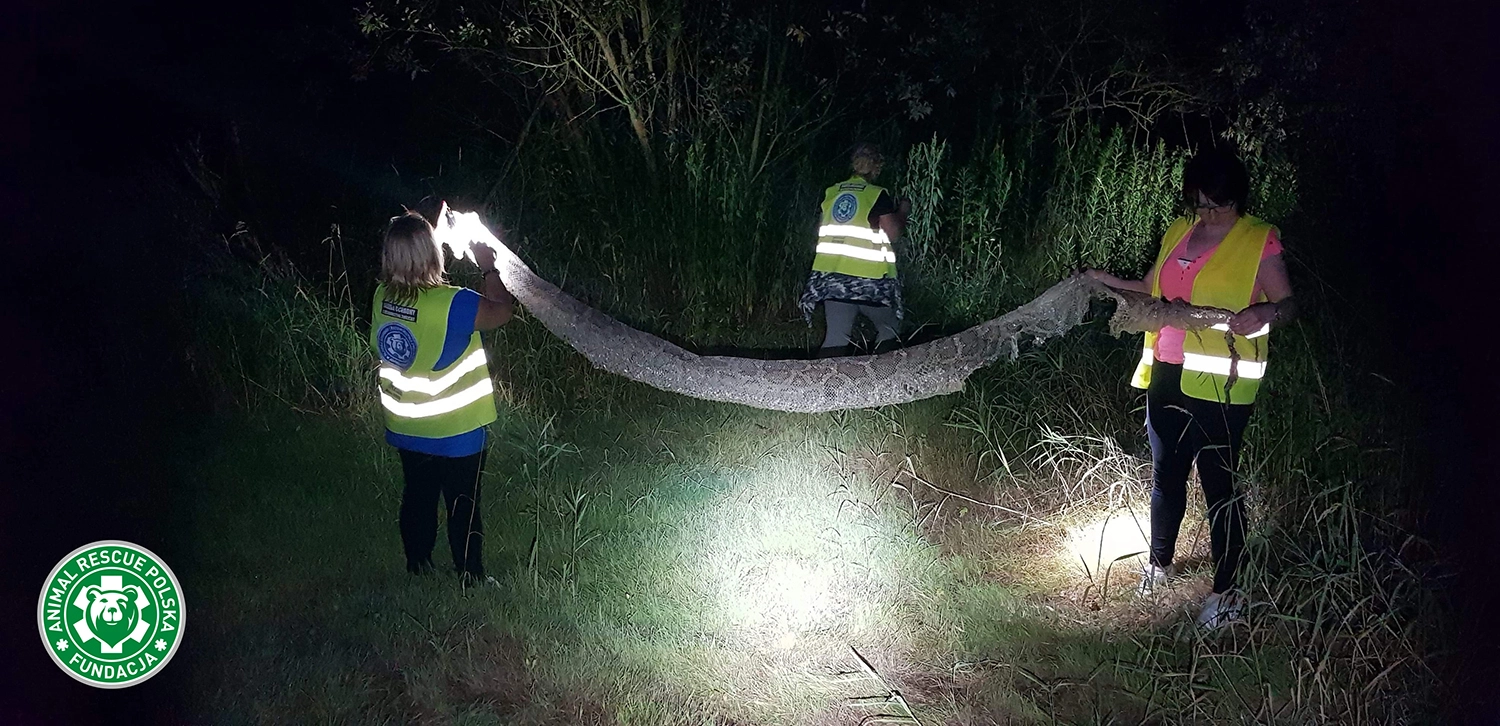
For nearly two months, a slippery fugitive has evaded capture in the Polish countryside. Nicknamed Bertha, she followed a serpentine path to escape her seekers' best efforts.
You might say that she slithered right through her would-be captors' hands.
Bertha is a rogue Indian python (Python molurus molurus), though few of those looking for her have actually seen her. Animal Rescue Poland (ARP) received reports on July 7 of shed snakeskin found near the Vistula River south of Warsaw that measured nearly 7 feet (2 meters). When ARP investigated the high grass closer to the river, they found a second piece of molted skin measuring about 16 feet (5 m), suggesting that the snake could be as long as 20 feet (6 m) from nose to tail tip, according to an ARP blog post. [Photos: Giant Pythons Invade Everglades]
ARP identified the snake as an Indian python — a species that is not native to Poland — describing it as an adult female that may have been released into the wild by an irresponsible breeder, ARP representatives wrote on Facebook. Having just molted, the snake was likely to be hungry and aggressive, and people should avoid walking or sleeping near the river while the snake search is underway, ARP warned.
On July 10, ARP shared a photo on Facebook showing a sinuous snake track in the mud, hinting at Bertha's passage, though the snake herself remained at large.
Since then, the ongoing quest for the elusive snake has captured the attention of people across Poland. Teams of experts combing the riverbanks include herpetologists, drone-deploying fire-brigade cadets, police officers and a drug-sniffing dog with the unlikely name of Cocaine, The Wall Street Journal (WSJ) reported yesterday (Aug. 28).
A team of 80 people using four boats and four drones has been probing the area, capturing more than 2,000 photos that biologists are analyzing for clues about Bertha's whereabouts, according to the New Zealand Herald.
Get the world’s most fascinating discoveries delivered straight to your inbox.

Police also investigated a photo taken from a hang glider, showing two men putting a large snake in a car, according to the WSJ. But the car — and the snake — belonged to a photographer who specialized in erotic images of snake-wrapped women, and the missing Bertha was not among the snakes that officials found in the man's home, the WSJ reported.
Indian pythons feed on rodents and other mammals, typically ambushing and biting their prey, squeezing it until it suffocates, and then swallowing it whole.
It's possible that Bertha is already far away from the places where authorities are still searching, Radoslaw Ratajszczak, biologist and director of the Wrocław Zoo in Poland, told the NZ Herald. Indian pythons are strong swimmers, and if Bertha dove into the river and rode the current, she could have traveled as far as 62 miles (100 kilometers), Ratajszczak said.
But even if Bertha manages to shake her many pursuers, her days roaming free in the Polish wilderness may be numbered, as she is unlikely to survive the cooler fall temperatures, Ratajszczak said.
Original article on Live Science.

Mindy Weisberger is a science journalist and author of "Rise of the Zombie Bugs: The Surprising Science of Parasitic Mind-Control" (Hopkins Press). She formerly edited for Scholastic and was a channel editor and senior writer for Live Science. She has reported on general science, covering climate change, paleontology, biology and space. Mindy studied film at Columbia University; prior to LS, she produced, wrote and directed media for the American Museum of Natural History in NYC. Her videos about dinosaurs, astrophysics, biodiversity and evolution appear in museums and science centers worldwide, earning awards such as the CINE Golden Eagle and the Communicator Award of Excellence. Her writing has also appeared in Scientific American, The Washington Post, How It Works Magazine and CNN.