













Flamingo Spotted in Texas, 13 Years After Escaping Kansas Zoo

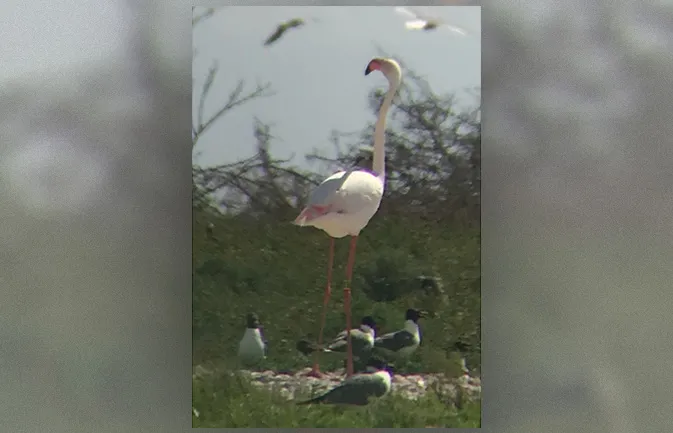
It's incredibly rare to catch a glimpse of an African flamingo on the Texas coast, but if you do, it's definitely Flamingo No. 492. The conspicuous pink bird has been on the run from the Sedgwick County Zoo in Wichita, Kansas, since escaping 13 years ago. Sightings of No. 492 have been rare, but the fugitive flamingo was spotted last month in Lavaca Bay, Texas, about halfway between Houston and Corpus Christi, The New York Times reported.
No. 492, along with 39 other flamingos, was sent to the Sedgwick County Zoo from Tanzania in 2003. Typically, zoos prevent flamingos from flying by amputating a part of their wing when they are newborns — a part that hasn't yet developed sensation. But the flamingos from Tanzania arrived at the zoo as adults, so curators there decided to clip the birds' feathers instead, as a more humane solution to keep the animals grounded, the Times reported. [In Photos: On the Lam: 10 of the Greatest Animal Escape Artists]
Clipped feathers grow back, however, and if they're not kept short, the bird will regain its ability to fly. So, in June 2005, flamingos No. 492 and No. 347 took advantage of their unclipped wings and flew out of their enclosure, the Times reported. The pair settled in a drainage canal where they evaded capture until a large thunderstorm forced them to separate. No. 347 went north to Michigan and hasn't been seen since.
But No. 492 moved south to Texas, where the bird found a great place to settle down. "As long as they have these shallow, salty types of wetlands, they can be pretty resilient," Felicity Arengo, a flamingo expert at the American Museum of Natural History in New York, told the Times. No. 492 found not only a great habitat, but also a companion: a Caribbean flamingo that was likely displaced during a tropical storm, the Times reported.
Ben Shepard, an intern with the Texas Parks and Wildlife Department, spotted No. 492 on May 23 while on a bird survey in Lavaca Bay. He didn't see No. 492's Caribbean companion, but experts told the Times this doesn't mean the companion is gone.
"It's possible they're separated and will show up back together again," Arengo told the Times. Experts also told the Times that No. 492 could live another 10 to 20 years, as flamingos can live well into their 40s.
Original article on Live Science.
Get the world’s most fascinating discoveries delivered straight to your inbox.

Kimberly has a bachelor's degree in marine biology from Texas A&M University, a master's degree in biology from Southeastern Louisiana University and a graduate certificate in science communication from the University of California, Santa Cruz. She is a former reference editor for Live Science and Space.com. Her work has appeared in Inside Science, News from Science, the San Jose Mercury and others. Her favorite stories include those about animals and obscurities. A Texas native, Kim now lives in a California redwood forest.