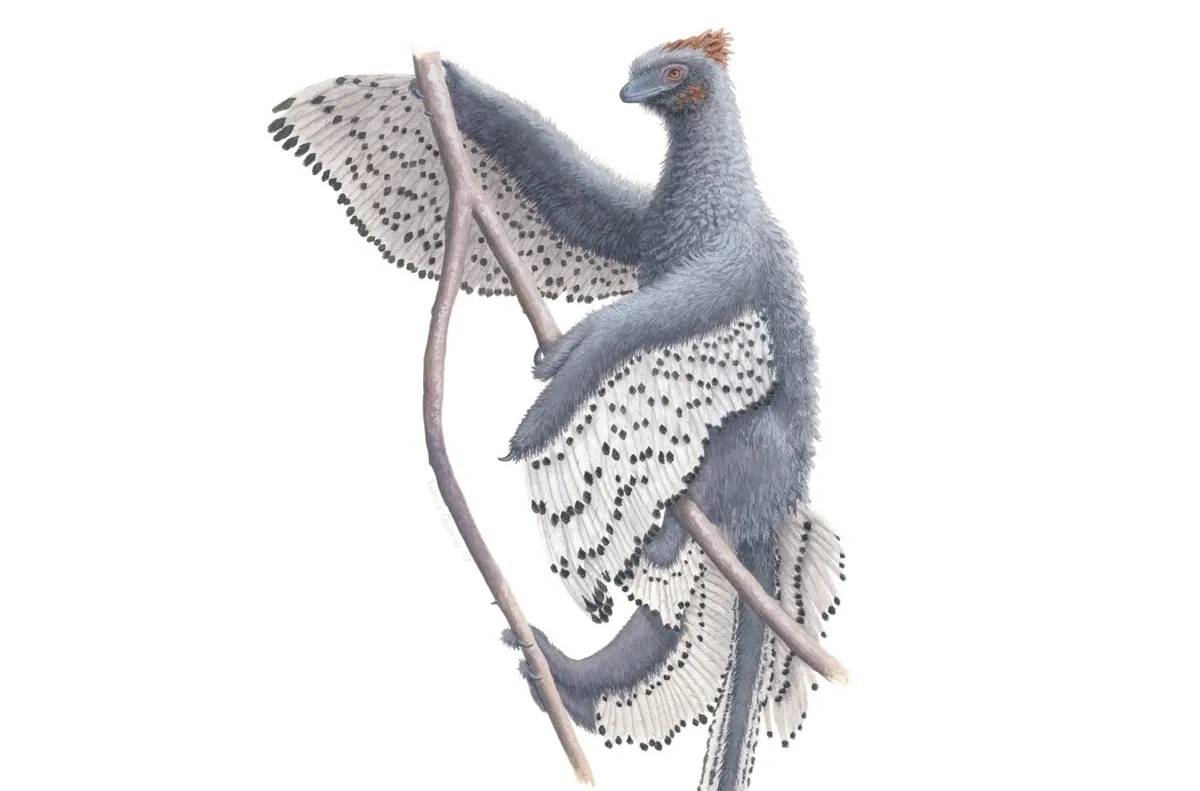
During the Jurassic period, some feathered dinosaurs — including the 160-million-year-old, crow-size Anchiornis huxleyi — were downright fluffy, unlike many of their sleek, modern bird relatives, a new study finds.
The finding shows that the feathers of Anchiornis, and another feathered dinosaur known as Sinosauropteryx, were simpler — and fluffier — than previously thought. Moreover, the dinosaur fossils in the study indicate that modern wings and feathers likely developed later along the evolutionary timeline than researchers had assumed.
"Overall, it does suggest that truly modern feathers and wings could have evolved later in time or in extinct bird lineages more closely related to modern birds than we might have expected," Evan Saitta, a paleontologist at the University of Bristol in the United Kingdom, who conducted the research, told Live Science. [Images: These Downy Dinosaurs Sported Feathers]
To investigate, Saitta and his colleagues examined the fossils of complete dinosaurs, as well as dinosaur feathers that had fallen off and fossilized. During their analysis, the researchers paid close attention to each feather's anatomy, including the rachis (the hard stem) and the barbicels — the hooked filaments that lock the individual fibers, called barbs, of a feather together.
An artistic rendering of the Anchiornis.
(Image credit: Rebecca Gelernter)
The researchers discovered that the outer, contour feathers found on the torso and limbs of Anchiornis had short stems and no barbicels. This means that the feathers branched out like plumes, giving the dinosaur a soft, fluffy appearance. These prehistoric, fluffy feathers are similar to those of a dove, which also has open and separated barbs.
In contrast, most modern bird feathers have a long stem and a network of barbicels that holds feathers together in a sleek, streamlined way that helps reduce drag during flight, the researchers said.
Meanwhile, contour feathers of the Sinosauropteryx lacked rachises altogether. Instead, these dinosaurs had feathery tufts emerging from their bodies. These findings still have to be confirmed, though, because fossils of stand-alone Sinosauropteryx feathers have yet to be discovered. Rather, the researchers made assumptions based on the imprints surrounding a fossil of the dinosaur.
Sign up for the Live Science daily newsletter now
Get the world’s most fascinating discoveries delivered straight to your inbox.
Anchiormis can also be distinguished from modern birds because it had multiple rows of long, droopy feathers on its four wings and tail, suggesting that it engaged in "wing-assisted leaping," or gliding, rather than true flight, the researchers said. In contrast, most modern birds have aerodynamic, asymmetrical feathers in just one single row on their two wings, they said.
Until this research, scientists had never observed feathers with a short rachis and long, separated barbs that branch out symmetrically as they do in Anchiornis, according to the study.
"The paper helps to fill in a gap with regards to the forms primitive feathers took," Saitta said.
In addition, the findings suggest that the fluffy, down-like feathers of Anchiornis made the dinosaur an ineffective flyer, but, like a winter coat, the feathers likely helped it keep warm.
Saitta and his colleagues plan to keep searching for more feathered dinosaurs, which might provide evidence that will help them study how primitive wings and feathers fit into the evolutionary timeline that eventually gave rise to birds.
A fossil of individual Anchiornis feathers next to a fossil of feathers resembling those of modern birds.
(Image credit: University of Bristol)
"Working out these relationships will help determine the timing and patterns of feather evolution," he said. "I cannot give you any precise geologic dates for these, though. There are a lot more fossils to be found."
The study was published online today (Nov. 28) in the journal Palaeontology.
Dan Robitzski is a staff writer for Live Science and also finishing up his master's degree at NYU's Science, Healthy & Environmental Reporting Program. Formerly a neuroscientist, Dan decided to switch to journalism and writing so that he could talk about transparency and accessibility issues within science. When he's not writing, he's either getting beaten up at fencing practice or enduring the dog breath of his tiny, affectionate Chihuahua. He also spends too much time on Twitter at @danrobitzski.