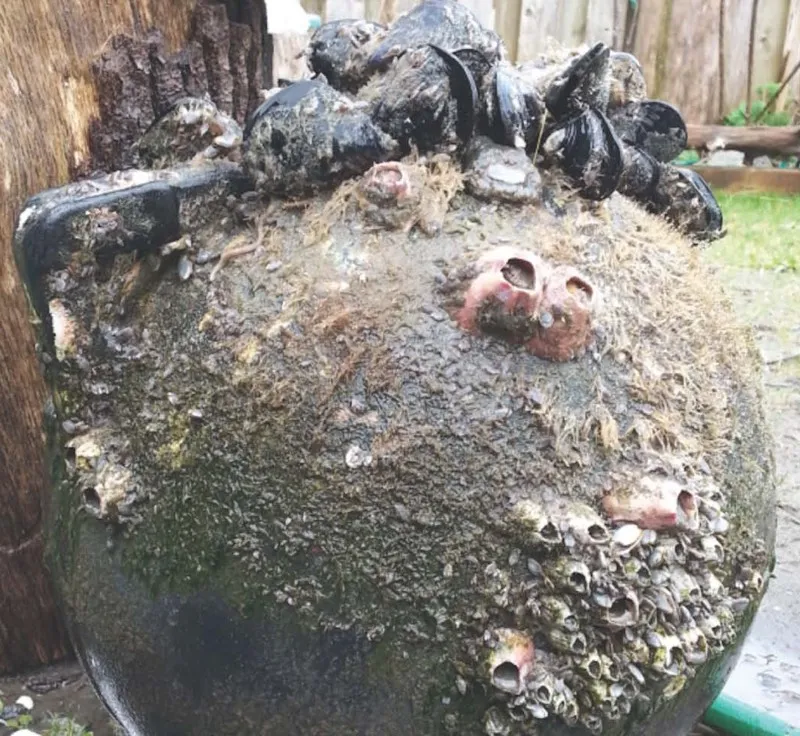
Japanese mussels (Mytilus galloprovincialis), barnacles (Megabalanus rosa) and sea anemones attached to a tsunami buoy washed ashore on Long Beach, Washington, in February 2017.
The devastating 2011 tsunami in Japan dragged several thousand tons of debris out to sea. Empty ships, splintered docks, wooden beams from homes, TV sets, refrigerators, buoys, buckets and plastic bottles crossed the Pacific Ocean in the months and years following the disaster.
The wreckage was a ghostly sight as it washed up on beaches from Hawaii to Alaska. But a new study claims the tsunami debris was actually teeming with life.
The researchers, who reported the discovery in the journal Science yesterday (Sept. 28), say it's the first time in recorded history that diverse communities of coastal species have rafted across an ocean.
Sea slugs from a Japanese vessel from Iwate Prefecture, washed ashore in Oregon in April 2015.
(Image credit: John Chapman)
"I didn't think that most of these coastal organisms could survive at sea for long periods of time," study co-author Greg Ruiz, a marine biologist at the Smithsonian Environmental Research Center in Maryland, said in a statement. The open ocean is thought to be a harsh environment for creatures that normally cling to the coasts.
But from spring 2012 to spring 2017, Ruiz and his colleagues counted at least 289 invertebrate and fish species arriving from Japan attached to debris, still alive. The creatures ranged from mussels and barnacles to sea stars, worms and jellyfish relatives. None had been previously known to raft across oceans, but Ruiz explained that these species just didn't have the opportunity to make the journey in the past.
"Now, plastic can combine with tsunami and storm events to create that opportunity on a large scale," Ruiz said.
Sign up for the Live Science daily newsletter now
Get the world’s most fascinating discoveries delivered straight to your inbox.
A Japanese barnacle (Megabalanus rosa) and native oceanic gooseneck barnacles in the Lepas genus were carried on a Japanese tsunami vessel, before washing ashore in 2014 in Long Beach, Washington.
(Image credit: James T. Carlton)
Indeed, the nonbiodegradable items like plastics, fiberglass and styrofoam continue to wash ashore; meanwhile, incidents of wooden wreckage coming ashore declined dramatically after 2014, according to the study.
"Given that more than 10 million tons of plastic waste from nearly 200 countries can enter the ocean every year —an amount predicted to increase by an order of magnitude by 2025 —and given that hurricanes and typhoons that could sweep large amounts of debris into the oceans are predicted to increase due to global climate change, there is huge potential for the amount of marine debris in the oceans to increase significantly," lead study author James Carlton, an invasive species expert with the Maritime Studies Program at Williams College in Massachusetts and Mystic Seaport in Connecticut, said in a statement.
The researchers worry that marine debris could be a vector for invasive species, which can disrupt local ecosystems. It's not clear yet if any of the ocean-crossing species from Japan will start colonies in California, Oregon or the other places where they've landed, but the researchers say the process could take years.
Megan has been writing for Live Science and Space.com since 2012. Her interests range from archaeology to space exploration, and she has a bachelor's degree in English and art history from New York University. Megan spent two years as a reporter on the national desk at NewsCore. She has watched dinosaur auctions, witnessed rocket launches, licked ancient pottery sherds in Cyprus and flown in zero gravity. Follow her on Twitter and Google+.