














Weird: How Does a Baby's 'Twin' End Up Inside His Abdomen?

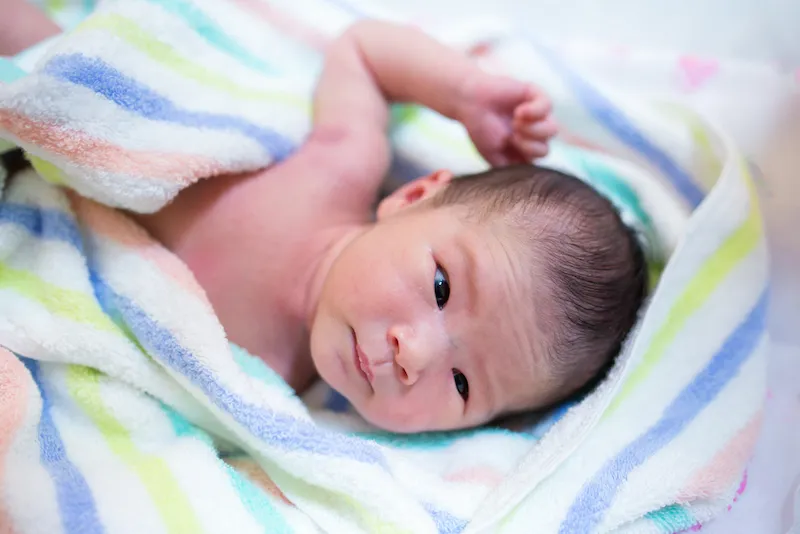
A baby boy in India was born with his own "twin" inside his abdomen — an extremely rare condition called "fetus in fetu." But what causes this to happen?
Doctors first noticed something was wrong when they spotted a mass inside the fetus during a routine ultrasound of the pregnant mother, according to Metro, a news outlet based in the United Kingdom. After the baby was born, doctors performed another scan, and found a partial fetus behind the baby's stomach. The partial fetus had arms, legs and a brain, but no skull, Metro reported.
Related: An X-ray showing 100 bubble tea pearls in a teen's abdomen has doctors very confused
The term "fetus in fetu," which literally means "fetus within fetus," is usually defined as a condition in which a developmentally abnormal fetus is found inside the body of its otherwise healthy twin.
It is not exactly clear what causes fetus in fetu. But scientists think the condition is likely a rare form of "parasitic twins," according to Arizona State University. Parasitic twins happen when, during an identical-twin pregnancy, one of the fetuses is absorbed by the other early in pregnancy. The tissues of the parasitic twin are dependent upon the body systems of the "host" twin to survive, according to a 2010 review paper on parasitic twins.
However, some researchers think that fetus in fetu is actually a kind of teratoma — a type of tumor that can contain all three of the major cell types that are found in an early-stage human embryo.
Fetus in fetu is very rare, occurring in only about 1 in 500,000 births, according to a 2010 report on the phenomenon.
Get the world’s most fascinating discoveries delivered straight to your inbox.
In the case of the Indian baby, doctors performed surgery to remove the 2.8-inch-long (7 centimeters) parasitic twin, which weighed about 5.3 ounces (150 grams), Metro said. Both the baby and the mother are reportedly doing well.
Original article on Live Science.

Rachael is a Live Science contributor, and was a former channel editor and senior writer for Live Science between 2010 and 2022. She has a master's degree in journalism from New York University's Science, Health and Environmental Reporting Program. She also holds a B.S. in molecular biology and an M.S. in biology from the University of California, San Diego. Her work has appeared in Scienceline, The Washington Post and Scientific American.