Mars Crater or Collapse? A Photo Mystery in Martian 'Swiss Cheese'
Get the world’s most fascinating discoveries delivered straight to your inbox.
You are now subscribed
Your newsletter sign-up was successful
Want to add more newsletters?
Delivered Daily
Daily Newsletter
Sign up for the latest discoveries, groundbreaking research and fascinating breakthroughs that impact you and the wider world direct to your inbox.
Once a week
Life's Little Mysteries
Feed your curiosity with an exclusive mystery every week, solved with science and delivered direct to your inbox before it's seen anywhere else.
Once a week
How It Works
Sign up to our free science & technology newsletter for your weekly fix of fascinating articles, quick quizzes, amazing images, and more
Delivered daily
Space.com Newsletter
Breaking space news, the latest updates on rocket launches, skywatching events and more!
Once a month
Watch This Space
Sign up to our monthly entertainment newsletter to keep up with all our coverage of the latest sci-fi and space movies, tv shows, games and books.
Once a week
Night Sky This Week
Discover this week's must-see night sky events, moon phases, and stunning astrophotos. Sign up for our skywatching newsletter and explore the universe with us!
Join the club
Get full access to premium articles, exclusive features and a growing list of member rewards.
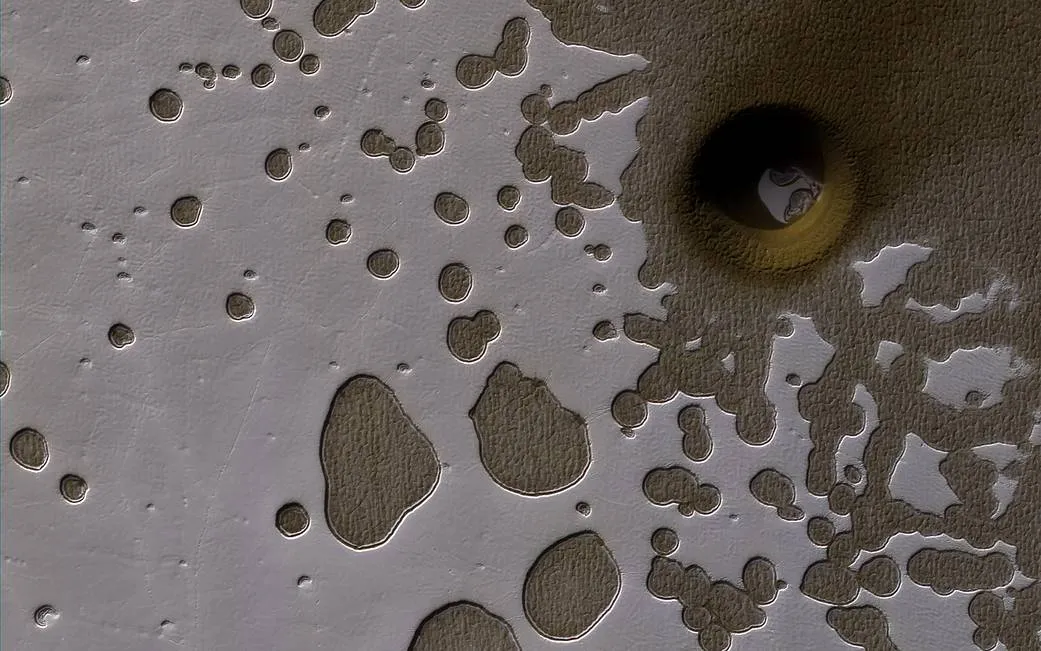
Scientists aren't sure if a big dimple on Mars came from something smacking into the Red Planet's surface or if was simply caused by a collapse.
A new image from NASA's Mars Reconnaissance Orbiter (MRO) shows several shallow pits among carbon dioxide ice, nicknamed "Swiss cheese terrain" because it looks a bit like the famous cheese.
But at upper right is a deeper pit that goes through the ice and dust, which NASA says could be an impact crater or some sort of collapse pit. [See more amazing Mars photos by MRO]
The picture was taken in the southern hemisphere of Mars late in the summer and unveiled Friday (June 2). At the time the image was taken, the sun was low in the Martian sky and the shadows it cast allowed for more "subtle" topography to show in the image, NASA officials.
MRO takes detailed pictures of the surface using the University of Arizona's High Resolution Imaging Science Experiment (HiRISE) camera. The spacecraft launched in 2005 and has been orbiting Mars since 2006.
Follow Elizabeth Howell @howellspace, or Space.com @Spacedotcom. We're also on Facebook and Google+. Original article on Space.com.
Get the world’s most fascinating discoveries delivered straight to your inbox.