













Phallic Curiosity: How a Whale Penis Came to the Explorers Club

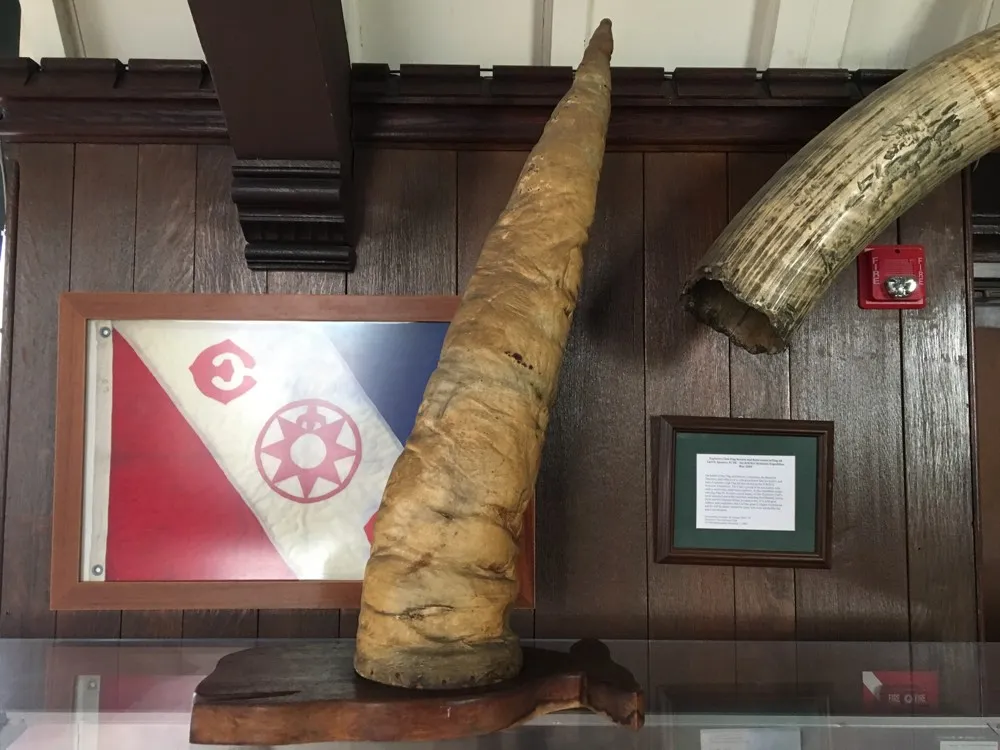
In 1977, the Explorers Club in New York received an unusual gift. Unable to attend a whaling exhibition that the club was hosting, Mr. and Mrs. Frederick S. Schauffler sent their regrets in a note … along with a sperm whale foreskin, stuffed and mounted on an oak base.
The penis stood out during a media tour of the club's headquarters in New York City related to the Explorers Club's 113th Annual Dinner in March. On the top floor, in a room called the Gallery, the cetacean phallus pointed skyward.
Frederick S. Schauffler was an Explorers Club member and U.S. naval captain, said Lacey Flint, the club's archivist and curator of research collections, who led the tour. Flint noted that according to the foreskin's record, it came from the collection of an individual named Edward Sanderson. Who Sanderson was and how Schauffler might have acquired the odd collectible, Flint did not know. [Photos: Inside the Explorers Club Headquarters]
According to a report by the Nantucket Historical Association, Sanderson was born in Ohio in 1874, but he lived his final years on the Massachusetts island of Nantucket. Sometime in the 1920s, he bought a historic Nantucket home and began filling it with whaling artifacts, such as "harpoons, boarding knives, cutting spades and bomb lances, as part of a careful interior restoration of that house," Aimee Newell wrote in the NHA report.
In 1929, Sanderson's collection outgrew his building, so he donated the trove to the NHA, which runs the Nantucket Whaling Museum. Sanderson's gift formed "the core of the NHA's whaling exhibits," Newell wrote. Apparently, Sanderson's collection also included a taxidermied sperm whale penis.
It seems that a Schauffler-Sanderson connection formed at least 15 years prior to the donation. In 1915, Sanderson, a minister, was in Brooklyn, New York, where he cofounded the New York branch of Goodwill Industries with a Rev. Dr. Henry Park Schauffler, according to Goodwill's history page. This may have been how the two met. Or the men may have met even earlier, as both Sanderson (in the late 1890s, according to NHA) and Schauffler (according to a 1930 article in The Brooklyn Daily Eagle published after Schauffler's death) attended Amherst College in Massachusetts and then Hartford Theological Seminary, and their studies may have overlapped.
Schauffler was survived by his wife, Grace Jarvis Schauffler, and five children, including a Frederick S., The Brooklyn Daily Eagle reported. So it seems that Sanderson's Goodwill co-founder, Henry Park Schauffler, was the father of Frederick S. Schauffler, who would, years later, donate an object from Sanderson's collection to the Explorers Club.
Get the world’s most fascinating discoveries delivered straight to your inbox.
But school and business were not the only Sanderson-Schauffler connections. In 1934, according to Newell's article, Sanderson married Grace Jarvis Schauffler, who was the widow of Sanderson's former business partner, Henry Park Schauffler. Sanderson became stepfather to Grace Jarvis Schauffler's children, including, of course, Frederick S., whose middle name, it turns out, was Sanderson (he went by "Sandy," according to articles published in a Nantucket newspaper, the Inquirer and Mirror, including this 1941 letter to the editor from Sandy himself.).
And it seems that it was under the name of "Sandy" that Schauffler became known as an accomplished skier. According to, among other sources, the "Legends" page of the Thunderbolt Ski Runners, a Massachusetts ski club, Sandy Schauffler was selected as a member of the U.S.'s Olympic ski team in 1940, but that year both summer and winter Olympics were canceled due to World War II, according to Wikipedia. By December, 1940, Schauffler had joined the Navy, according to an Inquirer and Mirror article. After the war, Sandy Schauffler was one of two men hired to survey Colorado for potential ski sites; he went on to cofound the Arapahoe Basin ski resort in that state, according to the resort's website. So although the Explorers Club does not have a record of why Schauffler was invited to join, Schauffler seems to have had his share of adventures.
Edward Sanderson died in 1955, according the Newell article. The whale penis from his collection continues to stand tall at the Explorers Club.
Original article on Live Science.

Ashley P. Taylor is a writer based in Brooklyn, New York. As a science writer, she focuses on molecular biology and health, though she enjoys learning about experiments of all kinds. Ashley's work has appeared in Live Science, The New York Times blogs, The Scientist, Yale Medicine and PopularMechanics.com. Ashley studied biology at Oberlin College, worked in several labs and earned a master's degree in science journalism from New York University's Science, Health and Environmental Reporting Program.