


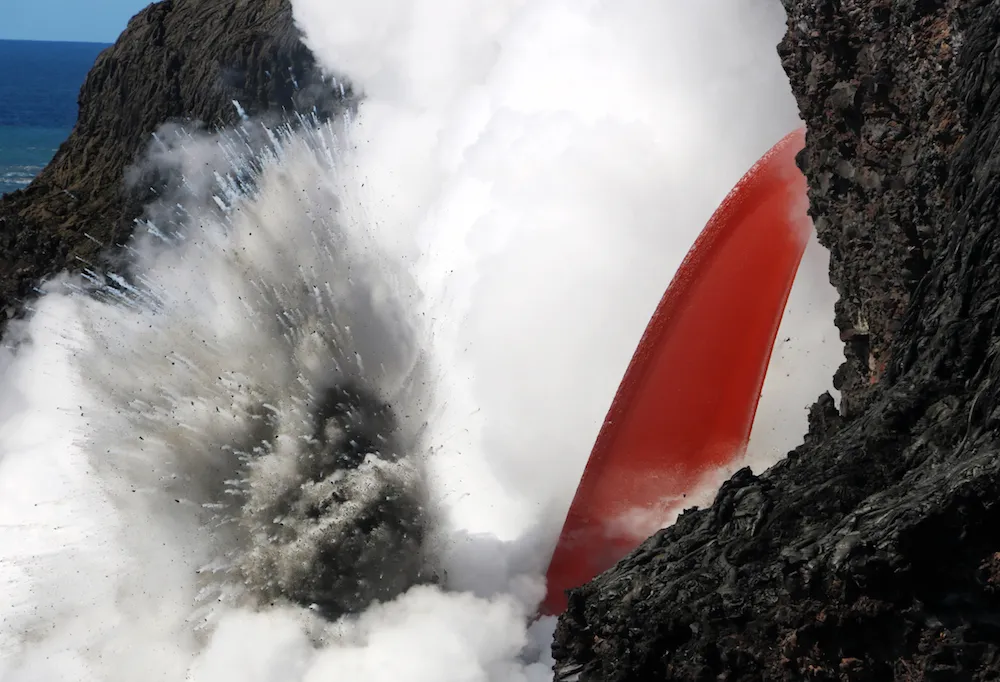
A stunning new video has captured a huge fire hose of lava streaming into the ocean at Hawai'i Volcanoes National Park.
The stream of lava is currently pouring into the ocean from a sea cliff near Kamokuna on the Big Island of Hawaii, according to the U.S. Geological Survey (USGS). When this massive lava chute hits the cool seawater below, the result is explosive steam.
Striking images show what looks like a giant bucket of red paint pouring into the ocean, surrounded by plumes of steam, ash, debris and gas. The ensuing steam explosions, which occurred Jan. 28 and Jan. 29, have tossed molten lava high up into the air, with some bits of molten rock catapulted to twice the height of the sea cliff. [See Amazing Video of Lava Fire Hose]
Yesterday (Jan. 30), a crack opened in the sea cliff above the lava tube which feeds the new lava stream. Volcanologists flying over the site used a special thermal-imaging camera to reveal the crack, which is now a scorching 428 degrees Fahrenheit (220 degrees Celsius), according to the USGS. On Jan. 28, volcanologists gingerly stepped onto the unstable surface to measure the crack, and found that it is 11.8 inches (30 centimeters) wide and cuts deeply into the new solidified lava laid down on the older sea cliff. This hot crack could be a sign that the entire sea cliff could come tumbling down, according to the USGS.
Hawai'i Volcanoes National Park is home to Kilauea, one of the world's most active volcanoes. The massive volcano has been erupting for 30 years, and the system has more than 200 structures, including the Pu'u O'O crater, a steaming caldera filled with a lava lake known as Halema'uma'u. The firehose of lava is part of Kilauea's long eruption.
The continuous eruption is also growing the Big Island, with a constant stream of lava from Pu'u O'O crater laying down new rock on the island as well as streaming into the ocean.
Originally published on Live Science.
Get the world’s most fascinating discoveries delivered straight to your inbox.

Tia is the editor-in-chief (premium) and was formerly managing editor and senior writer for Live Science. Her work has appeared in Scientific American, Wired.com, Science News and other outlets. She holds a master's degree in bioengineering from the University of Washington, a graduate certificate in science writing from UC Santa Cruz and a bachelor's degree in mechanical engineering from the University of Texas at Austin. Tia was part of a team at the Milwaukee Journal Sentinel that published the Empty Cradles series on preterm births, which won multiple awards, including the 2012 Casey Medal for Meritorious Journalism.