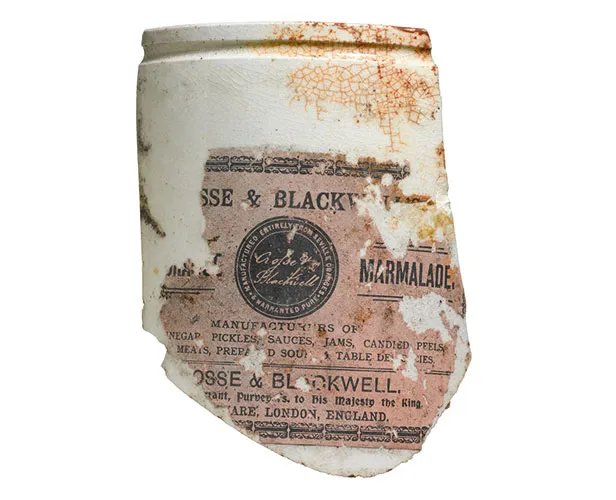
A buried cache of 13,000 jars and pots dating to the late 19th and early 20th centuries was recently unearthed at a site in London's Tottenham Court Road.
The objects represent a range of products made at that location by the well-known U.K. condiment manufacturer Crosse & Blackwell. And the find offers a window into the industry that shaped the British taste for condiments, researchers said.
Once intended to hold ketchup, pickles, marmalade, mustard, ginger and a variety of jams, the discarded ceramics and glassware — many of which are still intact — added up to about 6,614 lbs. (3,000 kilograms). Found at the former location of the Crosse & Blackwell factory, the jars had been placed in a cistern to serve as landfill, said a statement released Monday (Jan. 9) by the Museum of London Archaeology (MOLA). [The 25 Most Mysterious Archaeological Finds on Earth]
Crosse & Blackwell, still a noted producer of sweet and savory sauces, jellies, relishes, and chutneys, was founded in 1706 and relocated from its factory and storage facility on Tottenham Court Road in 1921; the site is currently under excavation to make way for an extension to the Elizabeth line in the London Underground metro system.
The cistern holding the 13,000 jars, pots and bottles was likely filled by Crosse & Blackwell as the company planned an expansion of its building complex. These recent finds offer tantalizing details about the production and consumption of condiments during the Victorian era, researchers said.
MOLA archaeologists discovered a large number of pots and jars at the Tottenham Court Road site.
(Image credit: Crossrail)
"We think this is the biggest collection of pottery ever discovered in a single feature from an archaeological site in London," Nigel Jeffries, medieval and later pottery specialist for MOLA, said in the statement.
The sweet smell of success
During the 19th century, Crosse & Blackwell was a well-established and successful name in the prepared-food industry. In 1864, the company produced 9 million bottles and pots bearing the Crosse & Blackwell label, more than nearly any other brand in the world, according to "The Food Industries of Europe in the Nineteenth and Twentieth Centuries" by Alain Drouard (Routledge, 2013).
Sign up for the Live Science daily newsletter now
Get the world’s most fascinating discoveries delivered straight to your inbox.
In fact, the site's prodigious output lent a notable odor to the neighborhood; a London medical officer for health described the scent at the time as a "suffocating effluvium." But however unpleasant the smells emanating from the factory may have been, the products themselves were endorsed by Queen Victoria and Napoleon's own chef, Signor Quallioti, MOLA reported.
Crosse & Blackwell's storage capacity in the mid-19th century was equally impressive, with the company's Soho warehouses holding an estimated 20,000 gallons of ketchup; 2,300 gallons of soy sauce; and 6,400 gallons of olive oil at any given time, Drouard wrote.
Archaeologists with Crossrail Limited, the organization conducting the excavation, also discovered warehouse basements that were "in good condition," according to a Crossrail statement. The group found a series of connected rooms with a refrigeration system, kiln and furnaces, as well as around 8,000 unused stoneware and ceramic pots stored in a single underground vault, likely abandoned when Crosse & Blackwell introduced glass bottles and jars, the excavators said.
Mindy Weisberger is a science journalist and author of "Rise of the Zombie Bugs: The Surprising Science of Parasitic Mind-Control" (Hopkins Press). She formerly edited for Scholastic and was a channel editor and senior writer for Live Science. She has reported on general science, covering climate change, paleontology, biology and space. Mindy studied film at Columbia University; prior to LS, she produced, wrote and directed media for the American Museum of Natural History in NYC. Her videos about dinosaurs, astrophysics, biodiversity and evolution appear in museums and science centers worldwide, earning awards such as the CINE Golden Eagle and the Communicator Award of Excellence. Her writing has also appeared in Scientific American, The Washington Post, How It Works Magazine and CNN.