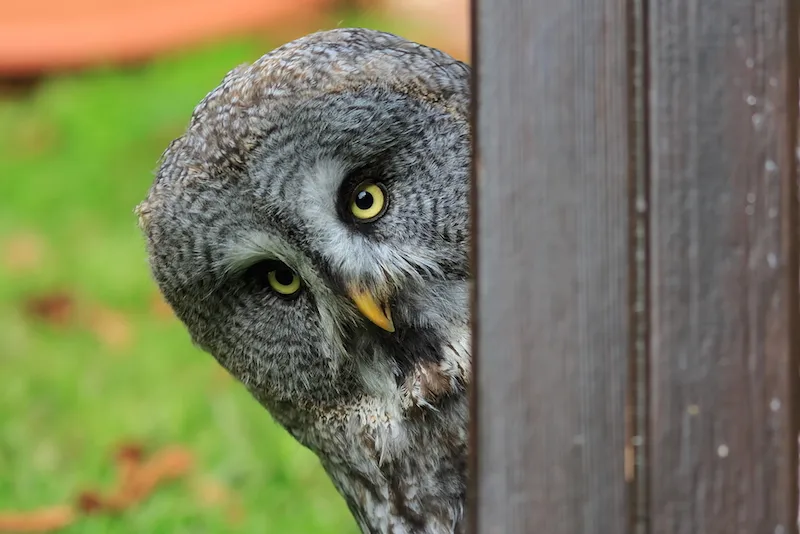
Owls are so famous for their nighttime escapades, that the phrase "night owl" developed to describe people who stay up late. But the saying is actually a bit misleading because some owls are active daytime hunters, experts told Live Science.
During the daytime, while some owls are sleeping, the northern hawk owl (Surnia ulula) and the northern pygmy owl (Glaucidium gnoma) are hunting for meals, making them diurnal — that is, active during the daytime, said Marc Devokaitis, a public information specialist at the Cornell Lab of Ornithology in Ithaca, New York.
Moreover, it's not uncommon to spot a snowy owl (Bubo scandiacus) or burrowing owl (Athene cunicularia) during the day, depending on the season and food availability, Devokaitis told Live Science.
Some owls are strictly nighttime owls, including the great horned owl (Bubo virginianus) and barn owl (Tyto alba). And others hunt during both the day and night, as well as the crepuscular times of dawn and dusk, when many prey are active, the experts said.
"Owls don't quite as clearly fall into nocturnal and diurnal as some other animals, because a lot of them are active during the daytime and nighttime," said Julie Ponder, a veterinarian and the executive director of The Raptor Center at the University of Minnesota.
The reason behind these varying sleep schedules largely has to do with prey availability, the experts said. For instance, the northern pygmy owl has a proclivity for songbirds, which are also awake during the day, the experts said. The northern hawk owl, which hunts during the day, as well as at dawn and dusk, eats small birds and voles and other diurnal animals.
Curious about Life's Little Mysteries?
Feed your curiosity with an exclusive mystery every week, solved with science and delivered direct to your inbox before it's seen anywhere else.
As the northern hawk owl's name implies, it looks quite hawkish. That's because owls and hawks are closely related, Devokaitis said. However, it's unclear whether the common ancestor they shared was diurnal, like the hawk, or nocturnal, like most owls, he said.
"Owls seem like a night-adapted bird that has then made forays into the daytime at various points in evolutionary history," he said.
This barred owl is fast asleep during the day.
(Image credit: Amber Burnette / The Raptor Center)
However, nocturnal owls certainly have advantages from their nighttime activities. Owls have excellent vision and hearing, both of which help them excel at nighttime hunting. In addition, the cover of darkness helps nocturnal owls avoid predators, as well as to attack prey, principally because their feathers hardly make any noise when they fly, Devokaitis said.
In addition, many rodents and other owl prey are active at night, giving the nocturnal owl species a smorgasbord of menu options, Devokaitis said.
"Some are evolved to hunt specific prey at a specific time, day or night," she said. "Others are more general and more able to adapt to what's needed."
Laura is the managing editor at Live Science. She also runs the archaeology section and the Life's Little Mysteries series. Her work has appeared in The New York Times, Scholastic, Popular Science and Spectrum, a site on autism research. She has won multiple awards from the Society of Professional Journalists and the Washington Newspaper Publishers Association for her reporting at a weekly newspaper near Seattle. Laura holds a bachelor's degree in English literature and psychology from Washington University in St. Louis and a master's degree in science writing from NYU.