















Here's Why the 400 Meter Gold Medal Win Was So Extraordinary

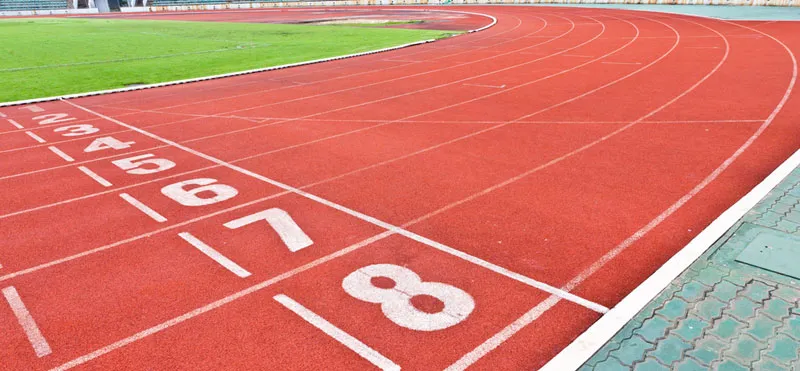
Olympic runner Wayde van Niekerk's gold medal win in the 400 meters last night is an extraordinary feat, and not just because he broke the world record for the event, but because of where he was placed on the track — in one of the very outside lanes, experts say.
In track and field, the middle lanes — lanes 3, 4 and 5 — are the most desirable, while the outside lanes have disadvantages, said Dr. Daniel Vigil, a sports medicine specialist at the University of California, Los Angeles.
The outside lane is undesirable in the 400 meters because the person in that lane can't see his or her competitors. This means that racers often can't pace themselves properly — they don't know if they're going too fast or too slow, Vigil said.
But van Niekerk won, with a world record time of 43.03 seconds, despite being placed in Lane 8, the outermost lane in his race.
"The fact that he overcame that and did as well as he did is truly extraordinary," Vigil told Live Science. "He ran that entire race without ever seeing his competitor... He basically ran in a bubble." [Olympic Form: How Sports Influence Body Shape]
Having a very keen ability to focus and a developed sense of discipline likely played a role in allowing van Niekerk to run at his record-setting pace without seeing his competition, Vigil said.
Running on the inside lane (Lane 1) is also a challenge for sprinting events such as the 200 and 400 meters, Vigil said. That's because, from the inside lane, the curve that people run along is so tight that it's difficult to run forward as fast as you could if you were running in a straight line. "You're fighting forces of gravity and physics," as you try to maintain speed, Vigil said.
Get the world’s most fascinating discoveries delivered straight to your inbox.
Track and field isn't the only sport in which middle lanes are advantageous — they are also desirable in swimming events. That's mainly because, in a body of water like a pool, the "flattest" water (with the least waves) is in the middle of the pool. So simply put, the middle of the pool is faster, Vigil said.
People with the best qualifying times are rewarded by being placed in the middle of the track (for sprinting events) and the pool, Vigil said.
Original article on Live Science.

Rachael is a Live Science contributor, and was a former channel editor and senior writer for Live Science between 2010 and 2022. She has a master's degree in journalism from New York University's Science, Health and Environmental Reporting Program. She also holds a B.S. in molecular biology and an M.S. in biology from the University of California, San Diego. Her work has appeared in Scienceline, The Washington Post and Scientific American.