













Rare Pottery Workshop Discovered in Galilee

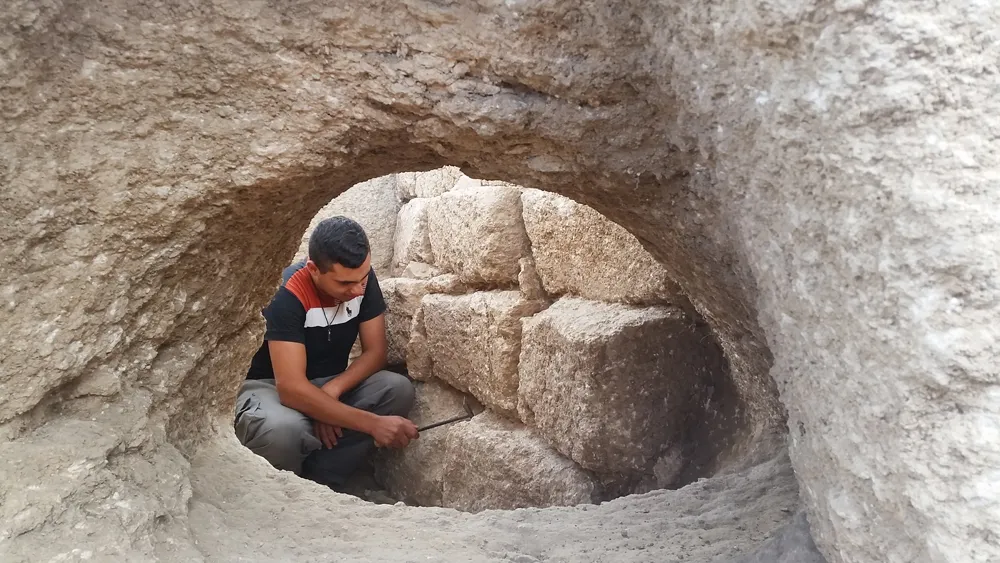
An ancient potters' workshop dating back to Roman times has been discovered in Galilee, in northern Israel.
The Israel Antiquities Authority announced that excavations in Shlomi, a town near the Lebanon border, have revealed a ceramic factory where storage jars and vessels for wine and oil would have been made 1,600 years ago. Archaeologists working at the site said this workshop is notable for its carefully constructed rock-cut kiln.
"What makes the pottery works so special is its unique kiln, which was hewn in bedrock and is unlike most of the kilns known to us that were built of stone, earth and mud," Joppe Gosker, the excavation director, said in a statement. [See Photos of the Roman Pottery Workshop]
The Roman kiln had two chambers: one firebox where branches and tinder would have been burned, and another chamber where the clay vessels would have been placed to harden under the intense heat.
"The ceramic debris that was piled up around the kiln indicates that two types of vessels were manufactured here," Gosker added. His team found fragments of storage jars that could be transported overland, as well as vessels known as amphoras that had large handles and were used to hold wine or oil, likely to be exported from Israel by sea.
Special geological conditions in Shlomi made the area a good spot for this rare type of kiln, said Anastasia Shapiro, a geologist with the Israel Antiquities Authority. According to Shapiro, the region has chalky bedrock, which is soft enough to be easily quarried and yet durable enough to endure the heat of the pottery-firing process.
Archaeologists have been excavating at Shlomi for the last six months ahead of the construction of a new residential area, according to the Israel Antiquities Authority. Part of the site will be incorporated into an archaeological park open to the public.
Get the world’s most fascinating discoveries delivered straight to your inbox.
The archaeologists also uncovered an ancient water-storage system and some mosaic floor tiles, and surveys in the area identified the remains of walls that probably date to the Byzantine period, or fourth century to seventh century A.D..
The Roman kiln is not the only industrial oven to be found in Israel recently. Earlier this year, archaeologists announced that they had discovered the oldest-known glass kiln in Israel, near Haifa, also dating back to the late Roman period, around the fourth century A.D.
Original article on Live Science.
