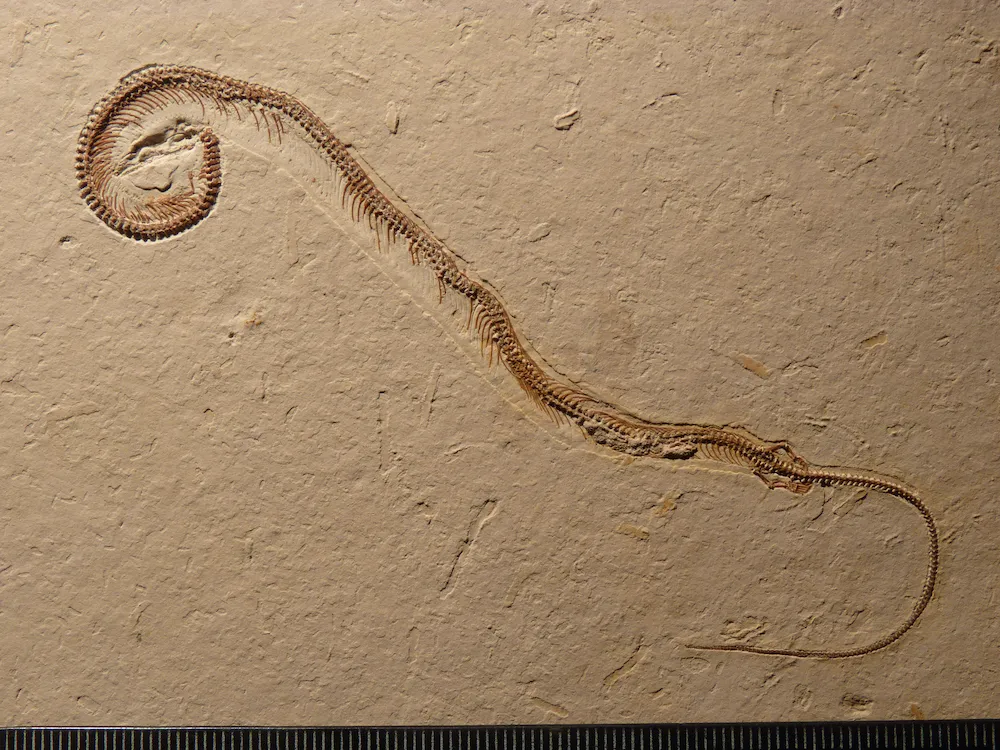
Snakes used to have four legs, according to a roughly 120-million-year-old fossil from northeastern Brazil. These legs likely weren't used for movement, but perhaps helped the snake mate or grasp prey, the researchers of the new study said. Like other snake fossils from the Cretaceous, this one is from Gondwana, suggesting that snakes originated on the southern supercontinent. [Read the full story on the four-legged snake]
Wrestling match
An artist's interpretation of the four-legged snake, dubbed Tetrapodophis amplectus, just after it caught a small mammal for its next meal. Paleontologists have yet to find fossil remains of mammals in the Crato Formation in northeastern Brazil, but "we know that they're in South America" during the Early Cretaceous, said co-researcher David Martill, a professor in paleobiology at the University of Portsmouth. It's likely that Tetrapodophis fed on lizards and small frogs in the tropical forests of Gondwana, he added. (Image credit: Julius T. Csotonyi.)
The entire skeleton of Tetrapodophis, with its head ending in a curly-q on the left. The specimen was on exhibit at the Solnhofen Museum in Germany, but its stunning feet escaped the notice of the scientific community until Martill spotted them during a visit to the museum. (Image credit: Dave Martill | University of Portsmouth.)
Foot photo
This close-up photo shows Tetrapodophis' rear feet. (Image credit: Dave Martill | University of Portsmouth.)
Sign up for the Live Science daily newsletter now
Get the world’s most fascinating discoveries delivered straight to your inbox.
Little hands
The hands of Tetrapodophis. (Image credit: Dave Martill | University of Portsmouth.)
Ancient battle
An illustration of Tetrapodophis capturing an ancient lizard in the genus Olindalacerta. (Image credit: James Brown | University of Portsmouth.)
Digestion central
The fossilized stomach contents of Tetrapodophis contain bits of bones, suggesting that the 7.8-inch-long (20 centimeters) critter ate ancient vertebrates. (Image credit: Helmut Tischlinger.)
Skull shot
The skull of Tetrapodophis. Notice its short snout and long braincase. (Image credit: Dave Martill | University of Portsmouth.)
Laura is the managing editor at Live Science. She also runs the archaeology section and the Life's Little Mysteries series. Her work has appeared in The New York Times, Scholastic, Popular Science and Spectrum, a site on autism research. She has won multiple awards from the Society of Professional Journalists and the Washington Newspaper Publishers Association for her reporting at a weekly newspaper near Seattle. Laura holds a bachelor's degree in English literature and psychology from Washington University in St. Louis and a master's degree in science writing from NYU.