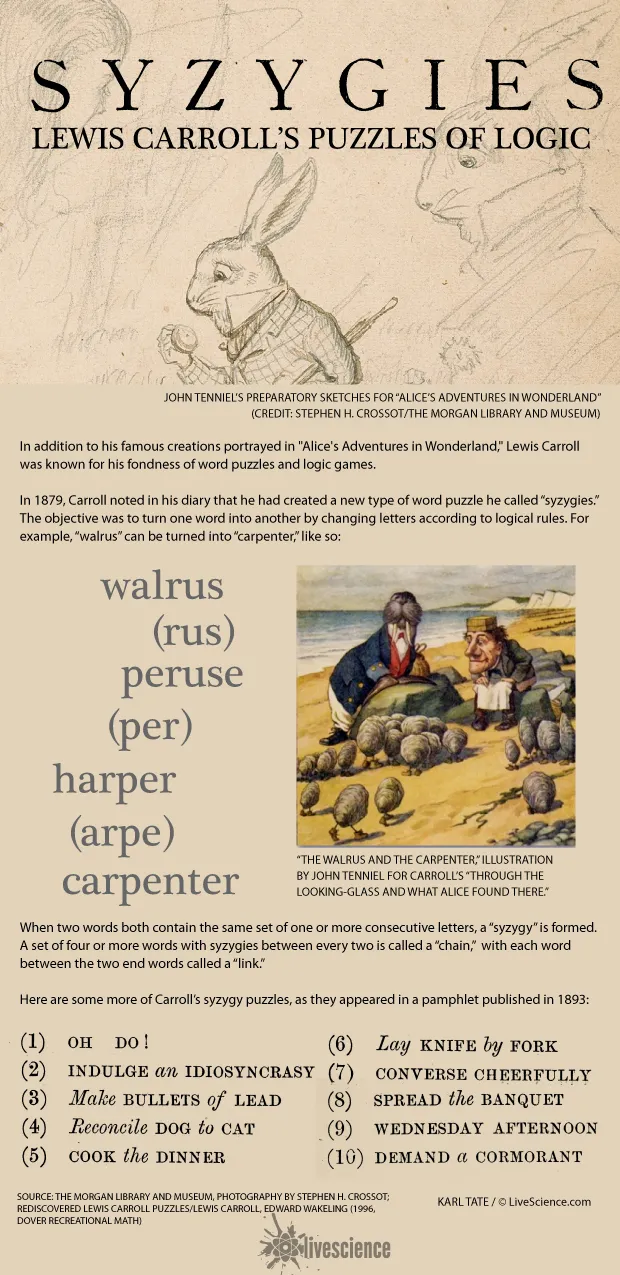
How Lewis Carroll's 'Syzygy' Puzzles Worked (Infographic)
Get the world’s most fascinating discoveries delivered straight to your inbox.
You are now subscribed
Your newsletter sign-up was successful
Want to add more newsletters?
Delivered Daily
Daily Newsletter
Sign up for the latest discoveries, groundbreaking research and fascinating breakthroughs that impact you and the wider world direct to your inbox.
Once a week
Life's Little Mysteries
Feed your curiosity with an exclusive mystery every week, solved with science and delivered direct to your inbox before it's seen anywhere else.
Once a week
How It Works
Sign up to our free science & technology newsletter for your weekly fix of fascinating articles, quick quizzes, amazing images, and more
Delivered daily
Space.com Newsletter
Breaking space news, the latest updates on rocket launches, skywatching events and more!
Once a month
Watch This Space
Sign up to our monthly entertainment newsletter to keep up with all our coverage of the latest sci-fi and space movies, tv shows, games and books.
Once a week
Night Sky This Week
Discover this week's must-see night sky events, moon phases, and stunning astrophotos. Sign up for our skywatching newsletter and explore the universe with us!
Join the club
Get full access to premium articles, exclusive features and a growing list of member rewards.
In addition to his famous creations portrayed in "Alice's Adventures in Wonderland," Lewis Carroll was known for his fondness of word puzzles and logic games.
In 1879, Carroll noted in his diary that he had created a new type of word puzzle he called “syzygies.” The objective was to turn one word into another by changing letters according to logical rules. For example, “walrus” can be turned into “carpenter,” like so:
walrus
(rus)
peruse
Get the world’s most fascinating discoveries delivered straight to your inbox.
(per)
harper
(arpe)
carpenter
When two words both contain the same set of one or more consecutive letters, a “syzygy” is formed. A set of four or more words with syzygies between every two is called a “chain,” with each word between the two end words called a “link.”
Here are some more of Carroll’s syzygy puzzles, as they appeared in a pamphlet published in 1893:
(1) OH DO!
(2) INDULGE an IDIOSYNCRASY
(3) Make BULLETS of LEAD
(4) Reconcile DOG to CAT
(5) COOK the DINNER
(6) Lay KNIFE by FORK
(7) CONVERSE CHEERFULLY
(8) SPREAD the BANQUET
(9) WEDNESDAY AFTERNOON
(10) DEMAND a CORMORANT