













In Images: The Amazing World of Antarctic Yeti Crabs
With its hairy chest and stark white shell, Kiwa tyleri is not your typical crab. This deep-sea creature, which makes its home atop the hydrothermal vents in Antarctica's Southern Ocean, is an extraordinary animal. First discovered in 2010, scientists have just published the first official description of this so-called yeti crab — one of just two other crab species belonging to the family Kiwaidae. [Read full story about the newly described yeti crab]
Living on the ridge

K. tyleri inhabits two separate areas along the East Scotia Ridge, an underwater volcanic ridge located in the Atlantic section of the Southern Ocean, between Antarctica and South America. The hydrothermal vents that dot the ridge exude geothermally heated water that can reach temperatures of 721 degrees Fahrenheit (382 degrees Celsius). The vents that K. tyleri inhabits are also home to stalked barnacles and sea anemones.
At the carwash

This photo shows a hydrothermal vent chimney nicknamed "Carwash." This type of vent, known as a "black smoker," spews out clouds of dark-hued, sulfur-bearing minerals. But despite its somewhat intimidating name, the vent makes a cozy home for the yeti crab. Hundreds of crabs will cling to a single vent chimney (and the areas surrounding these formations) to avoid the frigid waters of the Southern Ocean, which fluctuate between 29.7 degrees and 32.9 degrees F (minus 1.3 and 0.5 degrees C).
Cozy crabs

Talk about close quarters! Scientists estimate that as many as 600 yeti crabs cram together to fill a single square meter. Sven Thatje, lead author of the report detailing the animal's characteristics, called the crab's home a "thermal envelope" and explained that yeti crabs can't survive outside the pocket of heated water that surrounds the vents. Certain activities necessary for the species' survival — such as ventilation (i.e. breathing), molting (the process of shedding a shell) and mating — probably can't occur in waters colder than 32.9 degrees F (0.5 degrees C), Thetjan told Live Science.
Get the world’s most fascinating discoveries delivered straight to your inbox.
The "Hoff" crab
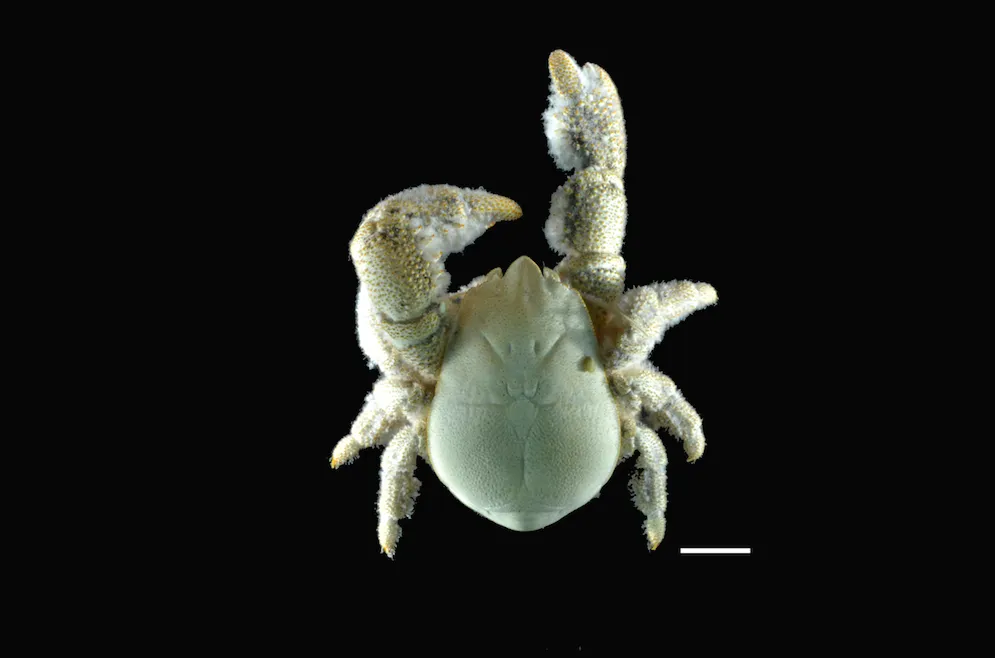
This male yeti crab has a hairy chest and equally furry arms, earning it the nickname "Hoff" crab (after the carpet-chested actor David Hasselhoff). The animal's furlike hair, or setae, serves two purposes. The bacteria that the crabs eat grow on the animal's setae, making the yeti crab both a garden and a gardener. And the animal's chest setae make it a gatherer, as well. These chest hairs are likely used to swipe up broad swaths of bacteria that grow on the hydrothermal vents, according to Thetjan.
Hot stuff

This photo shows a male (right) and female (left) yeti crab in their rocky habitat. The crabs live about 8,500 feet (2,600 meters)below the icy surface of the Southern Ocean, making it difficult for scientists to study these animals in their native environment. These pictures were captured in 2010 by a remotely operated submersible vehicle (ROV), which also scooped up a few samples for researchers to study in the lab. The slightly blurry quality of the image is caused by the hot water that escapes from crevices in the vent. The water is so hot it appears to "shimmer," Thetjan said.
Robot cam

In this picture, you can see both yeti crabs and the ROV that was used to collect them for further study. Front and center are the stalked barnacles that also inhabit the hydrothermal vents.
Strict diet

The male crab sitting atop this vent chimney is heavily covered in bacteria, which it collected and harvested using its setae. While the Antarctic crab's closest cousins, Kiwa puravida and Kiwa hirsute, are believed to also feed on mollusks, researchers think that Kiwa tyleri survives on bacteria alone.
Follow Elizabeth Palermo @techEpalermo. Follow Live Science @livescience, Facebook & Google+.