













Arctic Grows Stormier

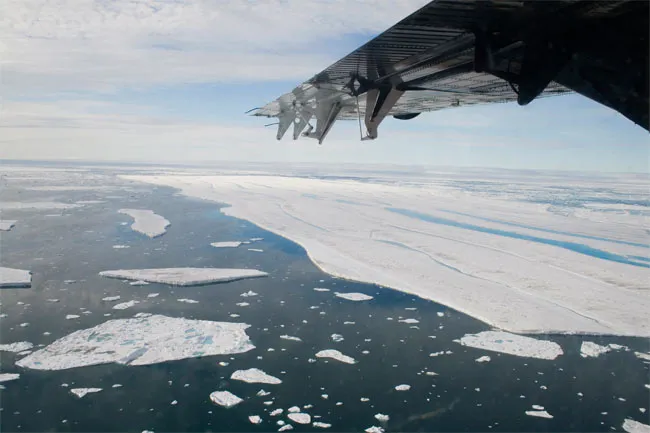
The Arctic has become more stormy in the past 50 years due to the warming climate, which in turn has quickened the pace of drifting sea ice, a new NASA study finds.
Based on model results, climate scientists had long predicted that a warming climate would increase the frequency and intensity of Arctic storms as ocean waters became progressively warmer.
Now, a team of climate scientists has analyzed 56 years on data of the paths that storms took, as well as annual data on general storm activity, which confirmed an accelerating trend in Arctic storm activity 1950 to 2006.
They also looked at data on ice drift in the Arctic collected during the same 56-year period and found that the pace of sea ice movement along the Arctic Ocean's Transpolar Drift Stream from Siberia to the Atlantic Ocean also accelerated.
Because wind at the ocean surface is known to be the driving force behind the movement of sea ice, the researchers concluded that the increase in Arctic storminess and the sea ice drift speeds are linked. The finding, detailed in the Oct. 3 issue of the journal Geophysical Research Letters, could reinforce the critical role that changes in the Arctic Ocean play in global ocean circulation and climate change.
"Gradually warming waters have driven storm tracks — the ocean paths in the Atlantic and Pacific along which most cyclones travel — northward. We speculate that sea ice serves as the 'middleman' in a scenario where increased storm activity yields increased stirring winds that will speed up the Arctic's transition into a body of turbulently mixing warm and cool layers with greater potential for deep convection that will alter climate further," said study team member Sirpa Hakkinen of NASA's Goddard Space Flight Center in Greenbelt, Md.
Progressively stronger storms over the Transpolar Drift Stream forced sea ice to drift increasingly faster in a matter of hours after the onset of storms, Hakkinen and her colleagues found. They saw an increase over 56 years in maximum summer sea ice speeds from about 8 inches per second (20 centimeters per second) to more than 24 inches per second (60 centimeters per second), and wintertime speeds from about 6 inches per second (15 centimeters per second) to about 20 inches per second (50 centimeters per second).
Get the world’s most fascinating discoveries delivered straight to your inbox.
The moving sea ice forces the ocean to move, which then sets off significantly more mixing of the upper layers of the ocean than would occur without the "push" from the ice. The increased mixing of the ocean layer forces increased ocean convection, which could create a counteracting force to climate warming, as it could help the ocean absorb more of the carbon dioxide accumulating in Earth's atmosphere.
"Although it remains to be seen how this may ultimately play out in the future, the likelihood this increasing trend and link between storminess and ice drift could expand the Arctic's role as a sink for extracting fossil fuel-generated carbon dioxide from the air is simply fascinating," Hakkinen said. "If it unfolds in the way we suppose, this scenario could, of course, affect the whole climate system and its evolution."
- Video: Arctic Storms Push Sea Ice
- North vs. South Poles: 10 Wild Differences
- The World's Weirdest Weather

Andrea Thompson is an associate editor at Scientific American, where she covers sustainability, energy and the environment. Prior to that, she was a senior writer covering climate science at Climate Central and a reporter and editor at Live Science, where she primarily covered Earth science and the environment. She holds a graduate degree in science health and environmental reporting from New York University, as well as a bachelor of science and and masters of science in atmospheric chemistry from the Georgia Institute of Technology.