













In Images: Antarctic Explorer Robert Falcon Scott's Last Photos
Photographs taken by Antarctic explorer Robert Falcon Scott during his ill-fated Terra Nova expedition are being auctioned off in London today (April 28). The explorer died in March 1912, just months after capturing these images. [Read full story about the photos and auction]

This photo shows the shelter built by the British explorer and his companions during the Terra Nova expedition to Antarctica in 1911. The building, on the frozen shores of Ross Island, is still standing today and is now known as "Scott's hut." It was abandoned by the remaining members of Scott's expedition in 1913 but was left stocked with food, oil and coal. These provisions have remained fairly well preserved to this day, thanks to Antarctica's sub-freezing temperatures. (Image credit: Robert Falcon Scott/Christie's Images Ltd. 2015)

Scott snapped this photo of the frozen slopes below Mount Erebus — the world's southernmost active volcano — in the winter of 1911. (Image credit: Robert Falcon Scott/Christie's Images Ltd. 2015)

This photo was taken on December 2, 1911, more than a month into Scott's ill-fated journey to the South Pole. More than a dozen Siberian ponies were transported to Antarctica for the Terra Nova expedition, but most of them died before Scott and his party began their trek to Earth's southernmost point. (Image credit: Robert Falcon Scott/Christie's Images Ltd. 2015)
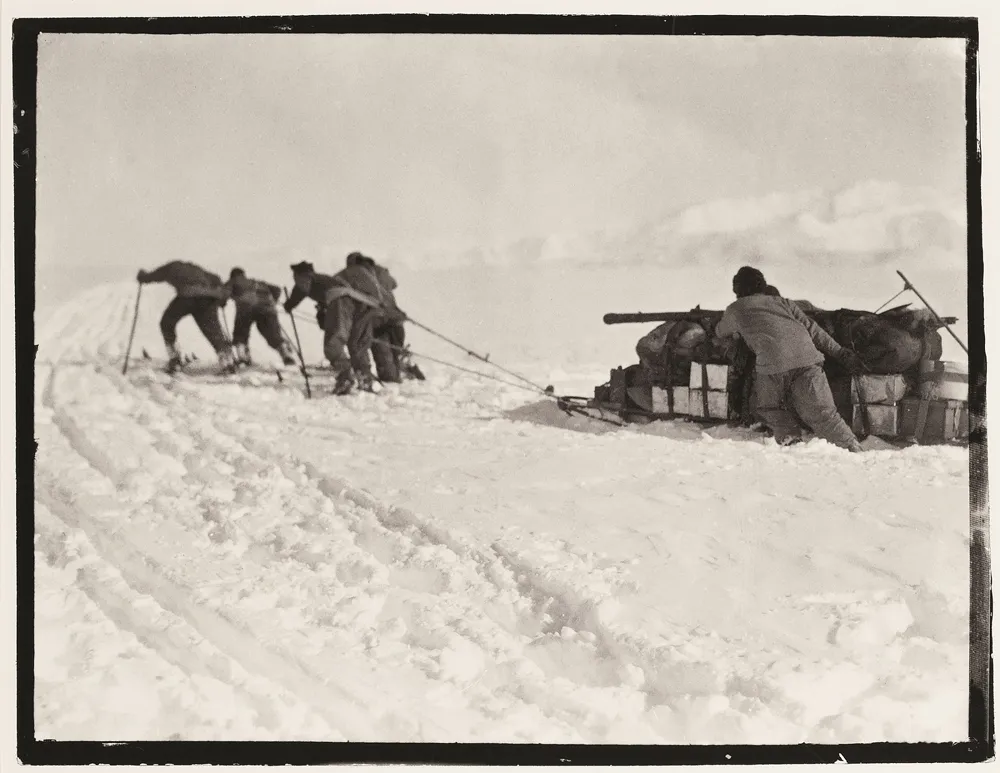
Men haul a loaded sledge onto smooth tracks in this photo, taken on December 13, 1911, on the Beardmore Glacier in central Antarctica. (Image credit: Robert Falcon Scott/Christie's Images Ltd. 2015)

In this photo, a group of ponies camps out on the Great Ice Barrier, or Ross Ice Shelf. Spanning nearly 200,000 square miles (487,000 square kilometers), this massive sheet of ice is the largest such shelf in Antarctica. (Image credit: Robert Falcon Scott/Christie's Images Ltd. 2015)

In this photo, Dr. Edward Wilson sketches the barren landscape of Beardmore Glacier. A physician and natural historian, Wilson accompanied Scott on both of his expeditions to Antarctica. He and Scott were allegedly close friends. The two men, as well as three others, died on the long march back from the South Pole in March 1911. Eleven of the photos that Scott took before his death will be auctioned off on April 28 in London. (Image credit: Robert Falcon Scott/Christie's Images Ltd. 2015)
Get the world’s most fascinating discoveries delivered straight to your inbox.
Follow Elizabeth Palermo @techEpalermo. Follow Live Science @livescience, Facebook & Google+.