













2011 Japan Tsunami Unleashed Ozone-Destroying Chemicals

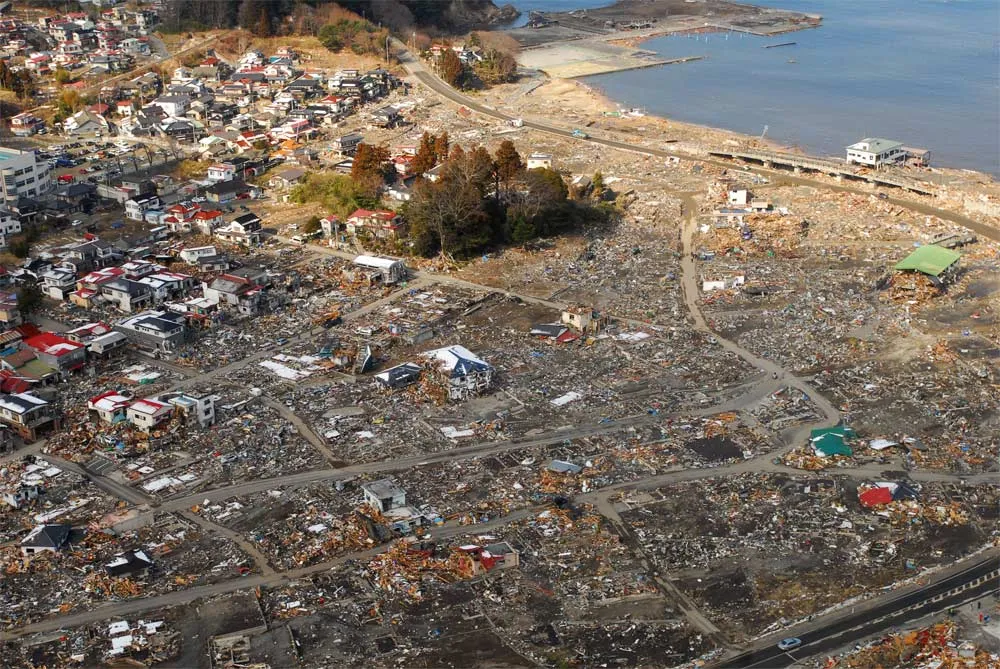
The 2011 tsunami that struck Japan released thousands of tons of ozone-destroying chemicals and greenhouse gases into the air, a new study shows.
Thanks to the country's strict building codes, the enormous magnitude-9 Tohoku earthquake left Japan's homes and businesses relatively untouched. But the earthquake triggered a deadly tsunami that roared through coastal cities and villages, destroying almost 300,000 buildings, according to the National Police Agency of Japan.
The damaged insulation, refrigerators, air conditioners and electrical equipment unleashed 7,275 tons (6,600 metric tons) of halocarbons, the study reported. Halocarbon emissions rose by 91 percent over typical levels in the year following the earthquake, said Takuya Saito, lead study author and senior researcher at the National Institute for Environmental Studies in Tsukuba, Japan. [In Pictures: Japan Earthquake & Tsunami]
"It was not a single, short-term pulse," Saito said.
The six halocarbons measured in the study are a group of chemicals that attack the Earth's protective ozone layer and can also contribute to global warming. The halocarbons include banned gases such as chlorofluorocarbons (CFCs), as well as hydrochlorofluorocarbons (HCFCs), which are being phased out of use. The researchers also found significant increases in hydrofluorocarbons (HFCs) and sulfur hexafluoride, both greenhouse gases.
Emissions of the banned chemical CFC-11 were 72 percent higher than before the March 11, 2011, earthquake. "This was surprising to us, because it had been banned in Japan 15 years before the disaster," Saito told Live Science in an email interview. "We had almost forgotten the fact that this ozone-depleting gas still exists around us."
About 50 percent of the halocarbon emissions after the earthquake were of HCFC-22. Its concentration rose by 38 percent between February 2011 and March 2012, the study reported. Emissions of HFC-134a and HFC-32 rose by 49 percent and 63 percent compared to the years before the quake.
Get the world’s most fascinating discoveries delivered straight to your inbox.
Saito and his colleagues launched the study after noticing unusually high emissions of the halocarbon HFC-32 at Cape Ochiishi in Hokkaido, Japan, following the earthquake. The researchers have studied atmospheric halocarbons at this site since 2006, Saito said. The researchers then took air-monitoring data from several stations in Japan and used atmospheric modeling to determine how much of the emissions were due to the 2011 earthquake and tsunami.
The findings were published March 12 in the journal Geophysical Research Letters.
Although the global effect of this one event is small, no countries account for natural disasters, such as earthquakes and tsunamis, in their annual estimates of greenhouse-gas releases to the atmosphere. "It is apparent that there are unreported emissions," Saito said.
The new study shows it may be necessary to include the amount of halocarbons released by catastrophic events in emissions estimates, Steve Montzka, a research chemist at the National Oceanic and Atmospheric Administration in Boulder, Colorado, who was not involved in the research, said in a statement.
Based on global halocarbon emission estimates, the extra emissions from the 2011 Tohoku earthquake would account for 4 percent or less of total global halocarbons, Saito said. And the halocarbons were weak contributors to global warming compared to carbon dioxide and methane. The gases released by the tsunami accounted for less than 1 percent of greenhouse gas emissions in the year following the earthquake.
Follow Becky Oskin @beckyoskin. Follow Live Science @livescience, Facebook & Google+. Originally published on Live Science.
