













Chameleon-like Material Changes Color On Demand
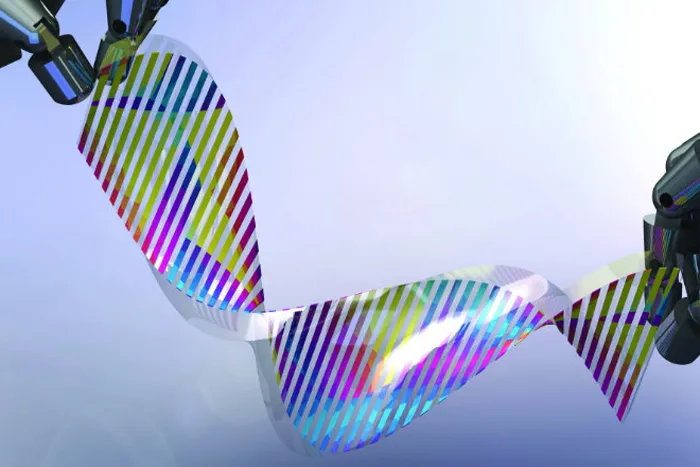
Researchers at the University of California at Berkeley announced today that they have developed an ultra-thin material that can change color on demand by bouncing back light on the nanoscale level.
Well, the on-demand element is a little more nuanced. The “chameleon skin” material actually changes color when flexed, or when a small amount of force is applied to the surface.
Chameleon’s Color-Changing Trick Taps Crystals: Photos
But because the material is much lighter and more flexible than previous efforts, the color-shifting effect could have a wide range of color-on-demand applications when applied to different surfaces.
It works like this: Tiny ridges — smaller than a wavelength of light — are etched into a layer of silicon film one thousand times thinner than a human hair. The silicon layer, approximately 120 nanometers thick, is flexible and functions as a skin that can be adhered to other surfaces.
Spacing of the ridges produces different colors. On top of that, the material is highly reflective — bouncing back up to 83 percent of incoming light, which makes it quite efficient at producing those colors.
The technology takes an entirely different approach to generating color, compared to what we’re typically used to seeing.
Get the world’s most fascinating discoveries delivered straight to your inbox.
With most natural materials — or paints or fabrics — color depends on chemical composition. When white light hits the surface of these materials, certain wavelengths of light are absorbed and the rest are reflected back, generating particular colors. Changing color, therefore, requires changing the chemical composition of the material.
The material developed by the UC-Berkeley team, on the other hand, leverages something known as structural coloration. The phenomenon isn’t new, and in fact occurs in nature all the time — those iridescent colors in peacock wings or beetle shells are generated by structural coloration.
Isaac Newton conjectured on the effect 300 years ago, and certain structural coloration techniques have been previously deployed in commercial and industrial applications.
Body Armor Based On Snake, Fish And Butterfly Scales
But the new technology promises much greater efficiency, flexibility and precision in generating specific colors. The research team says the silicon material could have wide-ranging applications in display technology, camouflage materials, or even as a way to visually indicate structural fatigue in buildings or bridges.
The paper was published today in the journal Optica.
Originally published on Discovery News.