Snowflakes may start as beautiful star-like crystals, but byt he time they hit the ground, they are far from beautiful (and often cause quite a mess). A new 3D camera is revealing why; learn more about the breakthrough in "Snowflakes Aren't Even Like Themselves, New 3D Images Reveal," the video below, and the following gallery.
Snowflakes are not so perfect
3D Christmas Flake2
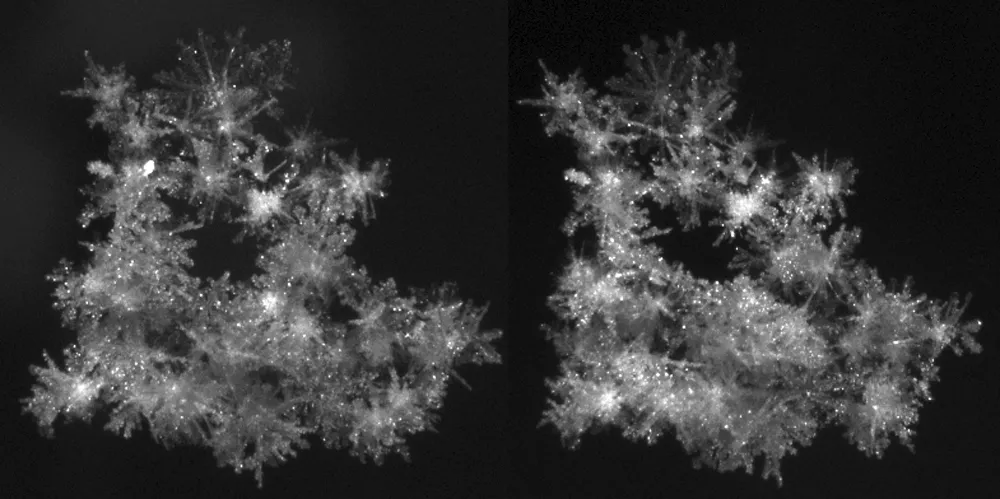
Using a two-camera system, the researchers can capture images in stereo. Even without special tools, if you look at the center of the image and unfocus your eyes, the two images merge into one, creating the illusion of a three dimensional ice crystal. (It can take practice, but it works!) (Credit: Cale Fallgatter.)
Pieces and parts
How snowflakes usually look: as aggregates. (Credit: Tim Garrett and Cale Fallgatter.)
Sign up for the Live Science daily newsletter now
Get the world’s most fascinating discoveries delivered straight to your inbox.
Stereo vision
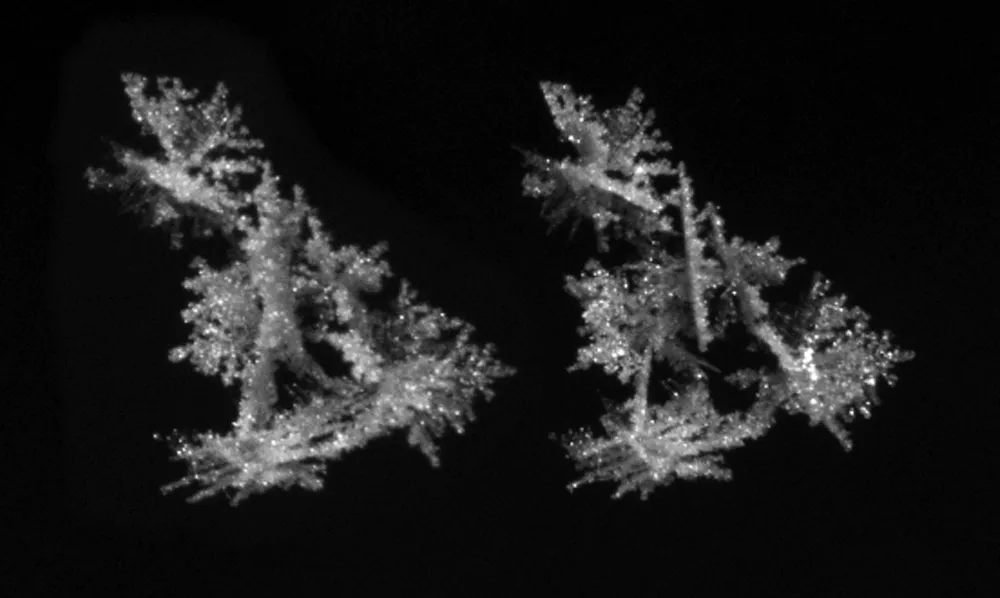
More snowflakes in stereo. (Credit: Cale Fallgatter.)
Almost frozen
Classifying precipitation near the freezing point of water is especially challenging. The new camera system developed with NSF funding provides information on particle composition, speed, size and angle. To see this image in 3-D, stare at the center of the picture and unfocus your eyes. (Credit: Cale Fallgatter.)
Falling free
A snowflake in freefall. (Credit: Cale Fallgatter.)
Follow all of the Expert Voices issues and debates — and become part of the discussion — on Facebook, Twitter and Google+. The views expressed are those of the author and do not necessarily reflect the views of the publisher. This version of the article was originally published on Live Science.
For the science geek in everyone, Live Science offers a fascinating window into the natural and technological world, delivering comprehensive and compelling news and analysis on everything from dinosaur discoveries, archaeological finds and amazing animals to health, innovation and wearable technology. We aim to empower and inspire our readers with the tools needed to understand the world and appreciate its everyday awe.