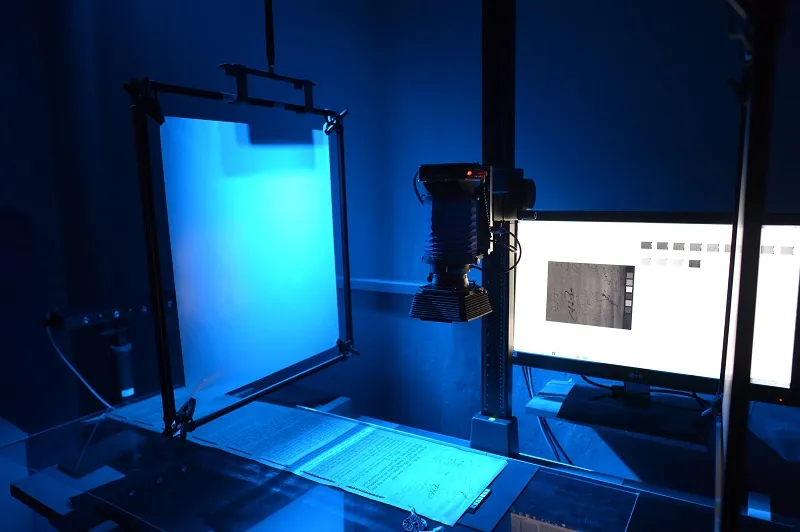
The original appearance of Israel's Declaration of Independence was recreated today (Jan. 6), using a high-tech photography technique that was first developed to help preserve the ancient Dead Sea scrolls.
Last year, archivists took a digital photo of the document, but the new recreation was made using a specialized camera system in the Lunder Dead Sea Scrolls Conservation Laboratory at the Israel Antiquities Authority.
The camera focuses several different wavelengths of light on the document, ranging from visible light to near-infrared light. The multi-spectrum image will make it possible to recreate the original texture of the scroll's material, ink and the intricacies of its surface. [Photos: A Walk Through Israel's Old Jaffa]
The visible light creates an exact color photo of the declaration, while the infrared light recreates the letters that have faded in the centuries since the document was first written. The result will be an accurate color and legible photographic copy of the historic document.
"It is exciting and symbolic to document the Declaration of Independence today, one of the cornerstones of the State of Israel, with technology developed specifically for the Dead Sea Scrolls — the earliest Hebrew texts, two thousand years old, which were first discovered on the eve of the establishment of the state, at the time when the Declaration of Independence was written," Pnina Shor, director of the Dead Sea Scrolls Project at the Israel Antiquities Authority, said in a statement.
Archivists carefully handle the document to get it ready for the high-tech photo.
(Image credit: Israel Antiquities Authority)
Archivists will also take advantage of the document being removed from its temperature- and light-controlled environment to evaluate the document's current state and identify any areas that need to be repaired. Experts will also plan how to best preserve the document.
Israel state archivist Yaacov Lozowick said experts are still deciding how to display the document to the public, so for now, efforts will focus on recording and preserving the declaration. Currently, the 46-inch-long (117 centimeters) and 12-inch-wide (30 cm) document will remain in its specially designed preservation facility, where it's kept behind lock and key.
Sign up for the Live Science daily newsletter now
Get the world’s most fascinating discoveries delivered straight to your inbox.
Israel's Declaration of Independence was proclaimed on May 14, 1948. Historians think the signed document is Israel's first record of its people's desire for a democratic state.
The Dead Sea Scrolls were discovered in 1947 in the Qumran caves in present-day Israel. The collection includes about 900 scrolls of papyrus and parchment. Researchers have dated the documents between the third century B.C. and A.D. 68.
The Dead Sea Scrolls document the lives of a Jewish sect called the Essenes. Historians do not agree on the significance behind the Dead Sea Scrolls, but most agree that the documents inspired parts of the New Testament in the Bible, even though there is no specific mention of Jesus Christ in the texts.
Kelly Dickerson is a staff writer for Live Science and Space.com. She regularly writes about physics, astronomy and environmental issues, as well as general science topics. Kelly is working on a Master of Arts degree at the City University of New York Graduate School of Journalism, and has a Bachelor of Science degree and Bachelor of Arts degree from Berry College. Kelly was a competitive swimmer for 13 years, and dabbles in skimboarding and long-distance running.