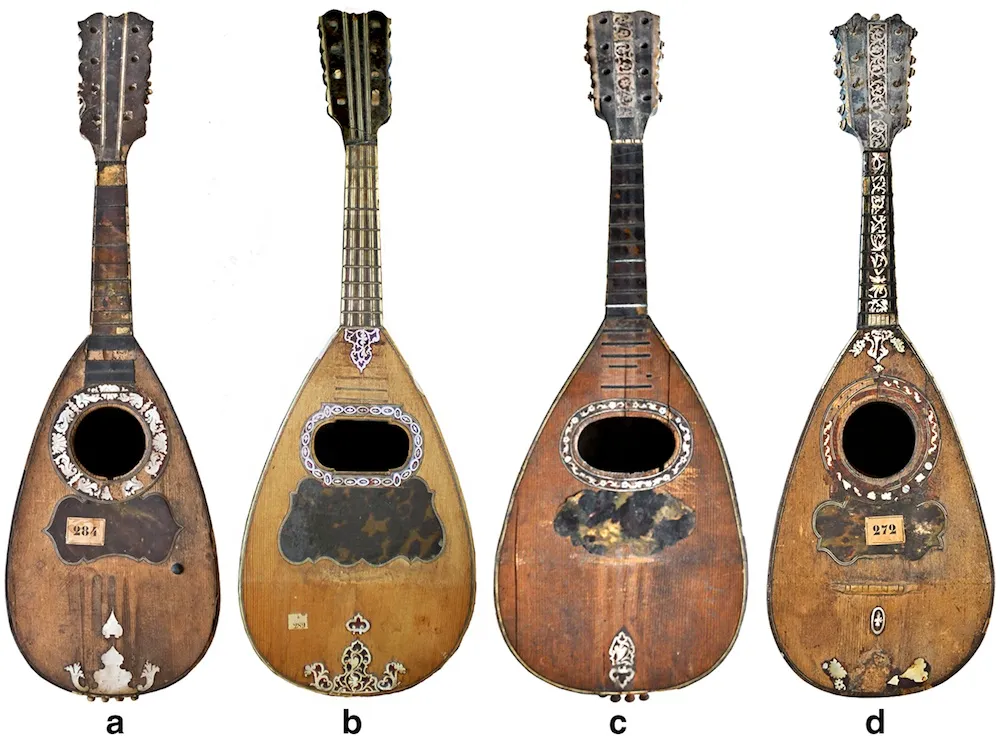
A 2014 study in the journal Applied Physics A has revealed the unique mix of materials used in the finish of stunning 18th-century mandolins made by master luthiers in Naples, Italy. Some of the mandolins studied are shown here: made by G. Filano 1765 (a), A. Vinaccia 1785 (b), G.B. Fabricatore 1789 (c) and G. Gagliano 1799 (d)
The secret behind the gorgeous color and decoration of rare 18th century mandolins has been revealed.
The ornate mandolins, built during a musical golden age in Naples, Italy, were primarily covered with shellac, a common finish that gives off a rich red hue. But each house of master craftsmen made its own unique mix with a few rare ingredients, including lava from Mount Vesuvius, according to a new study.
“For mandolins of unknown origin, our results could represent a new way to identify where they were made and therefore their historic and economic value,” study author Tommaso Rovetta, a researcher at the Università degli Studi di Pavia in Italy, said in a statement.
Musical heyday
In the 1700s, Naples was home to several musical innovations, from the flamboyant productions at its opera house to a distinctive "Neapolitan style" in instrumental music that spread across Europe, influencing the works of Mozart, Rossini and others, the researchers wrote in the paper.
Though Antonio Stradivari's coveted violins may fetch more money at auction, the Naples mandolin may have played a more instrumental role in the period's musical revolution. The deep-bowled mandolins, which produce more resonance than flat-backed American versions, first gained popularity in the 1700s. Musicians such as Beethoven and Paganini composed pieces specifically for the instrument.
Sign up for the Live Science daily newsletter now
Get the world’s most fascinating discoveries delivered straight to your inbox.
The Vinaccia family, a dynasty of master craftsmen that still makes guitars and violins today, first built the deep-bowled mandolin in the 1700s, and other families of luthiers, or makers of stringed instruments, followed suit. The most ornate of these instruments were painted with geometric designs and inlaid with bone, ivory or pearl.
For years, the materials and techniques used to make the stunning decoration was a closely guarded secret.
“We assume there were intense exchanges of technical know-how between masters and their apprentices, but, with no written records, this knowledge was taken to the grave,” Rovetta said.
Common ingredients
But Rovetta and his colleagues at the Laboratorio Arvedi Research Group got permission to take a closer look at 10 mandolins: one from a private collector and nine from the National Museum of Musical Instruments in Rome. All of the instruments were made between 1765 and 1799, and came from one of the four master luthier families of the time.
A mandolin made by G.Filano, shown here under UV light. The light causes fluorescence, particularly of the sound hole decoration. The reddish color is characteristic of the resin of the false inlay, which seems to be made mostly of shellac.
(Image credit: Rovetta/Canevari)
The team used light and scanning electron microscopy to analyze tiny samples of the resins on the musical instruments.
It turned out that shellac, a widely used, shimmery transluscent red finish made from the exoskeleton of the lac beetle, formed the base resin for all the mandolins. A unique mix of other ingredients, such as pigments and inorganic materials, were then added in, the researchers wrote in the paper.
One instrument, a 1796 Fabricatore, contained traces of volcanic lava from Mount Vesuvius. The Vinaccia mandolins contained diatoms, tiny algae with silica cell walls.
In addition to helping experts identify the finest mandolins, the findings may help improve the work of craftsmen today, the researchers wrote.
"We hope the rediscovery of ancient recipes will provide inspiration to today’s luthiers," Rovetta said.
Tia is the editor-in-chief (premium) and was formerly managing editor and senior writer for Live Science. Her work has appeared in Scientific American, Wired.com, Science News and other outlets. She holds a master's degree in bioengineering from the University of Washington, a graduate certificate in science writing from UC Santa Cruz and a bachelor's degree in mechanical engineering from the University of Texas at Austin. Tia was part of a team at the Milwaukee Journal Sentinel that published the Empty Cradles series on preterm births, which won multiple awards, including the 2012 Casey Medal for Meritorious Journalism.