$1 trillion trove of rare minerals revealed under Afghanistan

Despite being one of the poorest nations in the world, Afghanistan may be sitting on one of the richest troves of minerals in the world, valued at nearly $1 trillion, according to U.S. scientists.
Afghanistan, a country nearly the size of Texas, is loaded with minerals deposited by the violent collision of the Indian subcontinent with Asia. The U.S. Geological Survey (USGS) began inspecting what mineral resources Afghanistan had after U.S.-led forces had driven the Taliban from power in the country in 2004. As it turns out, the Afghanistan Geological Survey staff had kept Soviet geological maps and reports up to 50 years old or more that hinted at a geological gold mine.
In 2006, U.S. researchers flew airborne missions to conduct magnetic, gravity and hyperspectral surveys over Afghanistan. The magnetic surveys probed for iron-bearing minerals up to 6 miles (10 kilometers) below the surface, while the gravity surveys tried to identify sediment-filled basins potentially rich in oil and gas. The hyperspectral survey looked at the spectrum of light reflected off rocks to identify the light signatures unique to each mineral. More than 70 percent of the country was mapped in just two months.
Related: Facts about rare Earth minerals (Infographic)
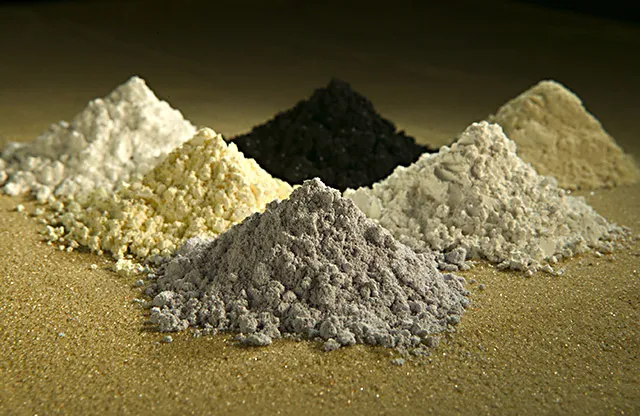
The surveys verified all the major Soviet finds. Afghanistan may hold 60 million tons of copper, 2.2 billion tons of iron ore, 1.4 million tons of rare earth elements such as lanthanum, cerium and neodymium, and lodes of aluminum, gold, silver, zinc, mercury and lithium. For instance, the Khanneshin carbonatite deposit in Afghanistan's Helmand province is valued at $89 billion, full as it is with rare earth elements.
"Afghanistan is a country that is very, very rich in mineral resources," Jack Medlin, a geologist and program manager of the U.S. Geological Survey's Afghanistan project, told Live Science. "We've identified the potential for at least 24 world-class mineral deposits." The scientists' work was detailed in the Aug. 15 issue of the journal Science.
Afghanistan treasure maps
In 2010, the USGS data attracted the attention of the U.S. Department of Defense's Task Force for Business and Stability Operations (TFBSO), which is entrusted with rebuilding Afghanistan. The task force valued Afghanistan's mineral resources at $908 billion, while the Afghan government's estimate is $3 trillion.
Get the world’s most fascinating discoveries delivered straight to your inbox.
Over the past four years, USGS and TFBSO have embarked on dozens of excursions in the war zone to collect and analyze mineral samples to confirm the aerial findings.
"Performing an assessment of mineral resources in Afghanistan is not like going out in the United States and doing normal field work," Medlin said. "What becomes very, very obvious in Afghanistan is the huge amount of pre-planning that has to take place in order to visit any site in that country, such as who is going to provide security and how much security is needed. You also have to plan how you are actually going to get to some place, as for most of the sites in Afghanistan, you cannot drive there — our work involved helicopters, and for our safety, we couldn't be on the ground very long to get samples."
The researchers' work has helped develop what are essentially treasure maps that let mining companies know what minerals are there, how much is there, and where they are, all to attract bids on the rights to the deposits. The Afghan government has already signed a 30-year, $3 billion contract with the China Metallurgical Group, a state-owned mining enterprise based in Beijing, to exploit the Mes Aynak copper deposit, and awarded mining rights for the country's biggest iron deposit to a group of Indian state-run and private companies.
"These resources provide the potential for Afghanistan to develop its economy, to create jobs and build infrastructure, as it goes into the future," Medlin said.
The mineral riches could lift Afghanistan out of poverty and fight crime and terrorism, said Said Mirzad, co-coordinator of the U.S. Geological Survey's Afghanistan program.
"Terrorists in Afghanistan exploited the misery of the local population," Mirzad said. "If you give the population jobs, if they could bring bread to the table, if they had something to defend, then the terrorists, who are very few in number, won't have sway."
Challenges to mining
However, developing a mining industry in Afghanistan faces major challenges. "One of the biggest challenges is security," Medlin said. "Another challenge is the lack of infrastructure. We're talking about access to energy, which is required to develop mines. We're talking access to roads, railroads and so forth. We're also talking about access to water, which is needed in most mining operations. It's all a big challenge, but it's doable. It won't happen overnight, but it's doable."
The USGS is currently helping to rebuild the scientific expertise of the Afghanistan Geological Survey, teaching the researchers modern techniques such as remote sensing. "We want to bring the Afghanistan Geological Survey into the 21st century," Medlin said. "The aim is to help the Afghans develop their mineral resources in a sustainable way."
Mining and other forms of natural resources development can lead to graft, corruption, social unrest and environmental degradation. Other nations rich in resources such as Botswana, Chile and Norway could provide Afghanistan good models to emulate in order to avoid these problems, said Marcia McNutt, who was editor-in-chief of the journal Science and director of the USGS in the summer of 2012.
For example, important factors contributing to peace and prosperity in those nations are strong public institutions, equitable redistribution of revenues, environmental planning and investment in education, scientific institutions and human resources, McNutt noted.
"The leaders of Afghanistan will have many important decisions to make in the coming years and decades," McNutt wrote in an editorial in the Aug. 15 issue of the journal Science. "Science has opened the door to a new, more prosperous future. May they use this opportunity wisely."
Originally published on Live Science.