













Russia's 'Sex Geckos' Perish in Space

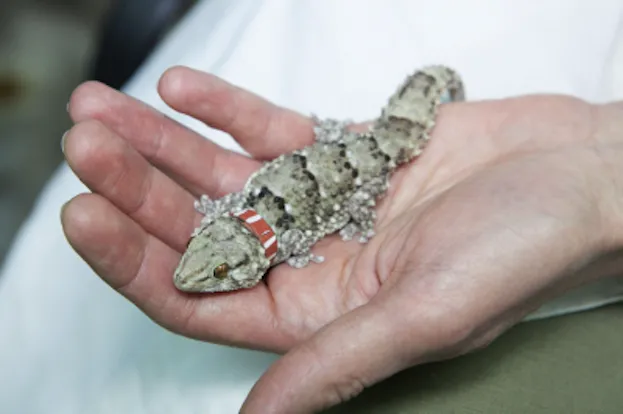
The geckos Russia sent to space to have sex have sadly perished, the Russian space agency said yesterday (Sept. 1).
The lovemaking lizards were launched into orbit for an experiment on mating and reproduction in a weightless environment, but all five of them (four females and one male) were found dead when the spacecraft carrying them returned to Earth, according to the space agency, Roscosmos.
The space agency launched the spacecraft carrying the Foton M4 satellite with the five live geckos on July 18, for a two-month mission. The mission's goal was to study the animals' mating, fertilization and embryonic development in a zero-gravity environment using an infrared camera, in addition to other biological and material experiments. [Animals in Space: 10 Beastly Tales]
The geckos garnered public attention when Russian officials lost contact with the satellite while it was in orbit on July 24. The story went viral when comedian talk-show host John Oliver announced a campaign on his show "Last Week Tonight" called "Go get those geckos." Russian space officials said they re-established contact with the capsule on July 26.
The satellite's landing apparatus fell to Earth in Russian's Orenburg region, as planned, at about 1:18 p.m. Moscow time, but none of the reptilian spacefarers made it out alive, according to the Roscosmos statement. The capsule also contained fruit flies, and those survived, the agency said.
An official at Russia's Institute of Biomedical Problems (ISTC), which conducted the experiment, said it was too early to discuss the animals' cause of death, but a representative from a scientific commission said preliminary information suggests the geckos died of hypothermia, the wire service Interfax reported. An equipment failure probably resulted in loss of control over the temperature of the animals' housing container.
The Russian mission is the fourth time geckos have journeyed to space. NASA and the Russian space agency are studying how these small reptiles reproduce in space, before they can move on to larger vertebrates, scientists say.
Get the world’s most fascinating discoveries delivered straight to your inbox.
Follow Tanya Lewis on Twitter and Google+. Follow us @livescience, Facebook & Google+. Original article on Live Science.
