













Secret Lives of Flower Hat Jellyfish Revealed

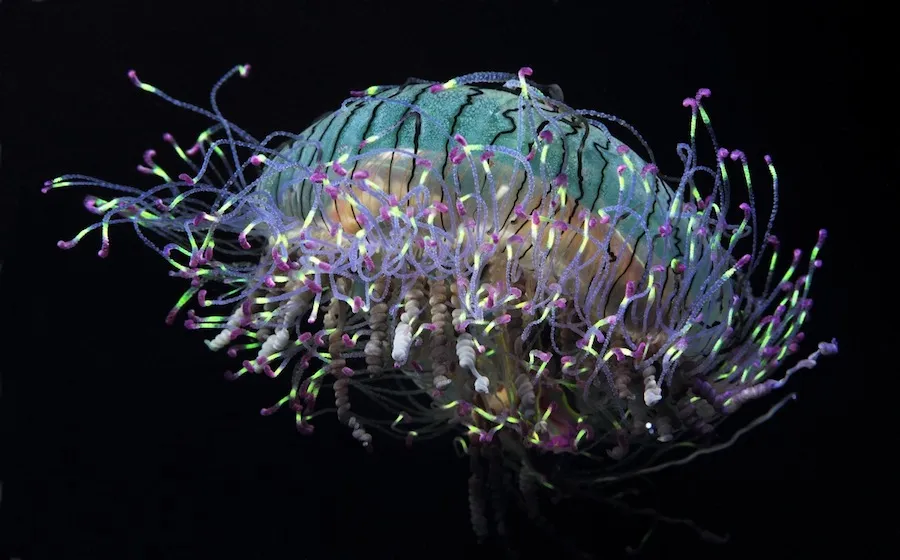
For decades, flower hat jellyfish managed to keep their early lives a secret.
In adulthood, the jellyfish are striking, with a nest of fluorescent tentacles that look like party streamers, but pack a nasty sting. In infancy, well, scientists didn't know. Aquarists tried, unsuccessfully, to raise the animals in tanks to understand what happens before the jellyfish are fully grown.
"They just aren't like other jellies," said Wyatt Patry, senior aquarist at the Monterey Bay Aquarium in California.
Now, Patry and colleagues report they've finally raised the jellyfish in captivity. In a new paper, the researchers describe the elusive species' life cycle, from egg to larva to single-tentacled polyp to juvenile to adult. [See Snapshots from the Life of Flower Hat Jellies]
Scientists at the aquarium first brought a group of flower hat jellies back from Japan in 2002 for an exhibit on jellyfish. At the time, aquarists tried to mate and culture the species (scientifically named Olindias formosus), but they just couldn't seem to get the jellies to release any sperm or eggs.
Patry said the researchers tried performing in vitro fertilization and exposing the jellies to stresses that might make them release sex cells. The creatures produced some larvae, but they didn't grow much larger than that stage. Ultimately, it seemed that the scientists were missing some cue the jellyfish needed for reproduction.
When it came time for another jellyfish show in 2012, the team tried again. They kept groups of flower hat jellies in small tanks with mesh netting to keep the creatures off the bottom, where detritus and rotting pieces of half-eaten fish settled. The scientists don't exactly know what they did right the second time around, but during routine maintenance, they discovered fluorescent jellyfish polyps attached to the wire mesh and glowing under a blue light.
Get the world’s most fascinating discoveries delivered straight to your inbox.
Jellyfish larvae attach themselves to a solid surface and become stalklike polyps, which then bud into juvenile "medusae" — what jellyfish are called when they reach their most recognizable, umbrella-shaped form. Jellyfish polyps persist for an unknown amount of time. The polyps of flower hat jellies were unusual in that they had a single, highly active tentacle.
"They just look like little sea anemones," Patry told Live Science. "They seem to use the tentacle to sweep around their position to capture food."
Patry hopes the new information might help scientists and wildlife managers look for the species in the wild — and predict when and where "blooms" of the jellyfish could affect beachgoers.
Flower hat jellies kill and eat entire fish, and their venom is powerful enough to inflict a painful rash on humans. The mark looks like a burn, said Patry. (Take it from him. He said he usually gets stung a couple of times a year.) A 2007 review of jellyfish incidents recorded around the world found one death associated with flower hat jellies, in Japan in the 1970s.
The findings on young flower hat jellies were published in June in the Journal of the Marine Biological Association of the United Kingdom.
Follow Megan Gannon on Twitter and Google+. Follow us @livescience, Facebook & Google+. Original article on Live Science.
