













Polar Dinosaurs Left Their Tracks
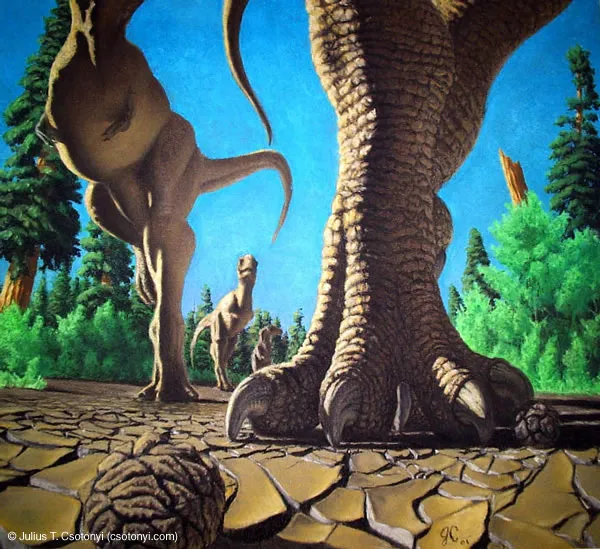
Newly discovered footprints made by carnivorous dinosaurs in Australia reveal the ancient beasts survived in polar climes when the outback was still joined to Antarctica and close to the South Pole.
The discovery of the three fossil tracks, each about 14 inches (36 centimeters) long and showing two to three partial toe-prints, was presented by Anthony Martin, senior lecturer in environmental studies at Emory University, today at a meeting of the Society of Vertebrate Paleontology in Austin, Texas.
The researchers estimate the tracks were made 115 million years ago during the Cretaceous Period by theropod dinosaurs, a group of bipedal carnivores that includes Tyrannosaurus rex. And based on the tracks' size, Martin and his colleagues estimate the beasts stood 4.6 to 4.9 feet (1.4 to 1.5 meters) at the hip. While not half-pints, the dinosaurs would've been about 20 percent smaller than Allosaurus, a large theropod from the Jurassic Period.
Martin spotted two of the tracks in February 2006 at the Flat Rocks site near Melbourne, and a year later at the same dig site, Tyler Lamb, an undergraduate student at Monash University in Melbourne, uncovered the third track.
"I think a lot more tracks are out there, but they've been too subtle to notice before now," Martin said.
Some 225 million years ago, Earth was dominated by one large continent, Pangaea, which ultimately broke apart.
The new tracks add to the fossil evidence of so-called polar dinosaurs dug up in Australia. Past research suggests the polar dinosaurs were adapted to the cold climate and were equipped with keen night-vision to help them snag food during the dark winters.
Get the world’s most fascinating discoveries delivered straight to your inbox.
- Video: Dino Race
- Image Gallery: Dinosaur Fossils
- A Brief History of Dinosaurs
Jeanna Bryner is managing editor of Scientific American. Previously she was editor in chief of Live Science and, prior to that, an editor at Scholastic's Science World magazine. Bryner has an English degree from Salisbury University, a master's degree in biogeochemistry and environmental sciences from the University of Maryland and a graduate science journalism degree from New York University. She has worked as a biologist in Florida, where she monitored wetlands and did field surveys for endangered species, including the gorgeous Florida Scrub Jay. She also received an ocean sciences journalism fellowship from the Woods Hole Oceanographic Institution. She is a firm believer that science is for everyone and that just about everything can be viewed through the lens of science.