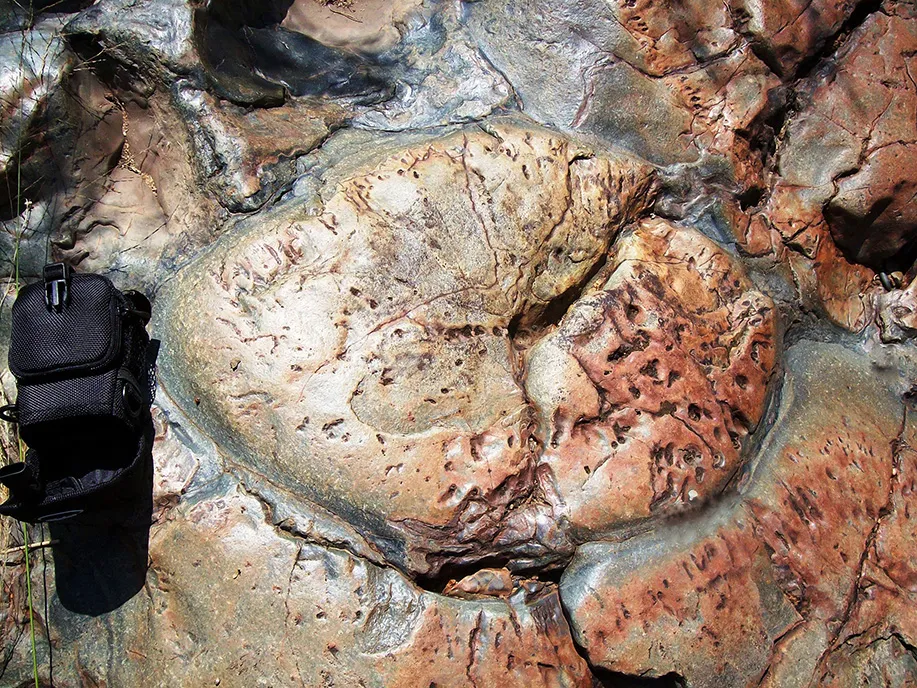
The volcanic basaltic pillow lava that erupted on the ocean floor around 3.472 billion years ago, now part of the Barberton Greenstone belt in South Africa. The rims of the pillow are glassy chilled margins that came into contact with water. The titanite microtextures occur in these dark glassy rims.
What were thought to be some of the oldest traces of life on Earth may not have been caused by life at all, new research suggests.
The fossils, tiny tubules etched into ancient rocks in South Africa, were initially thought to be formed by ancient bacteria boring through volcanic glass in the seafloor — a process called bioalteration — during the Archean Eon, about 3.4 billion years ago.
But the new study, published yesterday (May 26) in the journal Proceedings of the National Academy of Sciences, suggests these tiny tunnels were actually formed by the cooling of the volcanic rock nearby, just 2.9 billion years ago. [In Photos: Earth's Most Ancient Organisms]
"Our new data challenges this complex 'bioalteration model' proposed to have occurred in the Archean pillow lava rims," study co-author Eugene Grosch, an earth scientist at the University of Norway, wrote in an email to Live Science.
Traces of life
Several fossils have vied for the title of Earth's oldest life. Geologists thought rippling, wavy textures imprinted into rocks in the Dresser Formation in western Australia may have been formed by microbial mats about 3.4 billion years ago. At another formation in western Australia known as Strelley Pool, domelike structures called stromatolites may also have been formed by microbes nearly 3.5 billion years ago.
And in 2004, researchers digging at the Barberton Greenstone Belt in South Africa identified the newly analyzed microscopic filament structures, made of a mineral called titanite, that they believed were formed by ancient microbes in oceanic crust about 3.49 billion years ago.
Sign up for the Live Science daily newsletter now
Get the world’s most fascinating discoveries delivered straight to your inbox.
But finding the signature of tiny microbes that lived billions of years ago is extraordinarily difficult, and geologists hotly debate which of these specimens is truly the earliest hint of life on Earth.
Typical titanite microtexture in the pillow lavas found at the Barbertone Greenstone belt in South Africa
(Image credit: Eugene Grosch)
Mysterious formation
Grosch and his colleague Nicola McLoughlin, an earth scientist at the University of Norway, weren't convinced that the Barberton textures were formed by ancient microbes. To test that idea, the team drilled 590 feet (180 meters) into the rock where the textures were found.
They measured hundreds of the textures throughout the core and analyzed their size and shape distribution. The filaments had huge diameters and a very large size distribution compared with those of the miniscule tunnels formed by microbes in oceanic crust today, Grosch said.
The team also used the decay of uranium and lead isotopes (elements with the same number of protons but a different number of neutrons) to estimate the age of the titanite. (Because these elements decay at different rates, the ratio of the two can reveal the age of the rock.)
Not life?
The tiny trace fossils were formed between 2.9 billion and 2.8 billion years ago, so they're about 650 million years younger than the formation as a whole.
The team also used a mathematical model of the cooling conditions in nearby pillow lava and found that the titanite structures were likely formed by the prevailing conditions in the cooling rock at that time.
About 2.9 billion years ago, magma intruded into the even more ancient rock and heated it up, forming the titanite structures as it cooled, the team thinks.
These findings discount the notion that the trace fossils were formed by primitive microbes at the dawn of life on Earth, the researchers argue.
"These textures are not biological or related to microbial activity," Grosch said.
Tia is the editor-in-chief (premium) and was formerly managing editor and senior writer for Live Science. Her work has appeared in Scientific American, Wired.com, Science News and other outlets. She holds a master's degree in bioengineering from the University of Washington, a graduate certificate in science writing from UC Santa Cruz and a bachelor's degree in mechanical engineering from the University of Texas at Austin. Tia was part of a team at the Milwaukee Journal Sentinel that published the Empty Cradles series on preterm births, which won multiple awards, including the 2012 Casey Medal for Meritorious Journalism.