













Computers Simulate 50 Percent of a Mouse Brain
A team of researchers from the IBM Almaden Research Lab and the University of Nevada successfully simulated the neural activity of half of a mouse brain on a BlueGene L supercomputer that had 4,096 processors, each one of which used 256MB of memory.
James Frye, Rajagopal Ananthanarayanan, and Dharmendra S Modha set forth their methods in a provocatively titled research note "Towards Real-Time, Mouse-Scale Cortical Simulations".
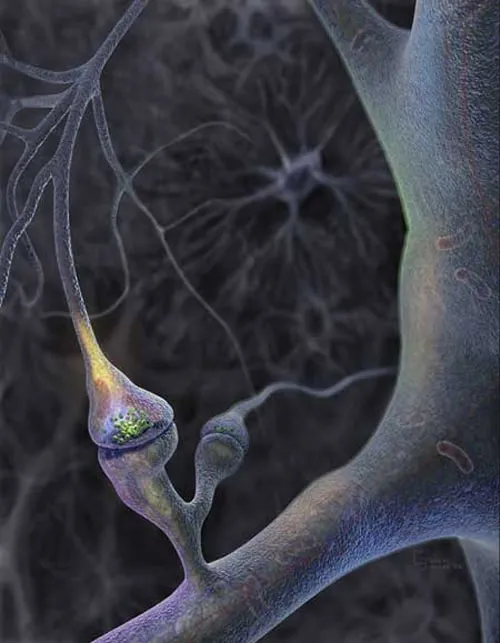
What is a mouse brain, that we should wish to move towards simulating it? One half of a real mouse brain has about eight million neurons, each of which has up to eight thousand connections (synapses) with other neurons; it's a very complex system, with a staggering amount of processing power.
The simulation was so computationally intensive that the supercomputer could not even handle real-time mouse cogitation. The researchers ran the simulation at one-tenth speed for only ten seconds.
The researchers say that the simulation does not model the real structures of a mouse brain, although in smaller scale tests they had seen "biologically consistent dynamical properties" in the simulations.
Science fiction fans have been waiting for this one, because it proves that even the most fanciful ideas of sf writers can have value. In his 1962 short story Think Blue, Count Two, Cordwainer Smith wrote about an interstellar space craft that used an enormous light sail to move from star to star over centuries. No human pilot could live long enough; the ship with its miles of sails was controlled by a computer. But what computing device could possibly be found that would be powerful, small and light - because every pound mattered?
Laminated mouse brains, of course.
Get the world’s most fascinating discoveries delivered straight to your inbox.
"This brain isn't frozen," said Tiga-belas indignantly. "It's been laminated. We stiffened it with celluprime and then we veneered it down, about seven thousand layers. Each one has plastic of at least two molecules thickness. This mouse can't spoil. As a matter of fact, this mouse is going to keep on thinking forever. He won't think much, unless we put the voltage on him, but he'll think. And he can't spoil..."
(Read more about the Laminated Mouse Brain Computer )
There are some scientists who are working on harnessing the power of the living brain cells of small mammals. Dr. Yael Hanein of Tel Aviv University is working on Brain Chips With Uniform Self-Organized Neurons Dr. Thomas DeMarse has created a "brain in a dish" that can play games - see Rat Neurons In A Dish Now Playing Flight Simulator. DeMarse's work was presaged by science fiction writer Peter Watts, who wrote about cultured brains (he called them head cheese ) in his 1999 novel Starfish.
Don't miss these other science-fiction, science-fact mouse brain articles:
Read more about the simulation at the BBC. (This Science Fiction in the News story used with permission from Technovelgy.com - where science meets fiction.)