













Bird Brains Actually Brilliant
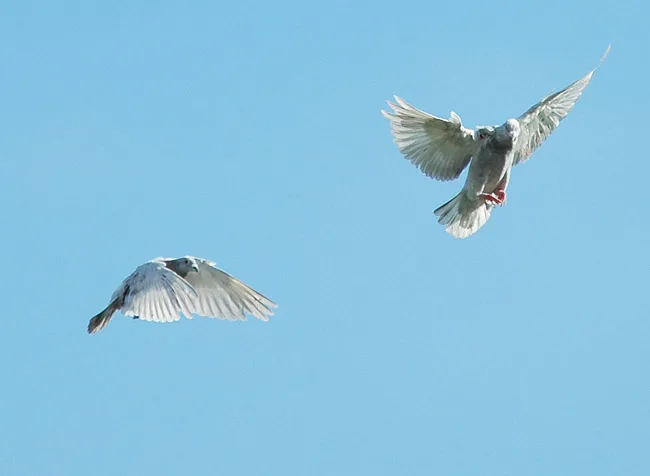
You might squawk at being called birdbrained, but if you are ever called "pigeon brained," take it as a compliment.
In two recent studies, scientists discovered the common pigeon is astonishingly sophisticated, having an amazing long-term memory and the ability to make group decisions based on different sets of conditions.
Researchers led by Dora Biro of the University of Oxford used miniature GPS tracking devices to study how pairs of homing pigeons decide between two attractive options—following a tried-and-true route home and flying alongside another homing pigeon.
When both birds in the pair had similar flight paths, the birds compromised and both flew by an intermediate route. When the pair’s preferred routes differed greatly, one bird emerged as a leader whose path both birds followed.
In the same study, detailed today in the journal Current Biology, the scientists showed that birds flying in pairs took more efficient routes home than those flying alone, suggesting that traveling in numbers brings navigational benefits to individual group members.
In another study, researchers led by Joël Fagot of the Mediterranean Institute of Cognitive Neuroscience tested pigeon and baboon memories. For each memory trial, the animals viewed a randomly selected picture on a computer screen with two color choices illuminated. Since the correct response was randomly chosen, yet permanently assigned at the outset, the task required memorization of each picture and its associated response.
Baboons memorized a minimum of 3,500 to 5,000 items and didn’t reach a limit at the end of the three to five-year study. Pigeons memorized 800 to 1,200 pictures before reaching their limit, a capacity that “is considerable and would represent a rich library of information and experience to draw on during their daily activities,” the researchers note this week in the journal Proceedings of the National Academy of Sciences.
Get the world’s most fascinating discoveries delivered straight to your inbox.
- Parrot Grasps Concept of Zero
- Bird's Warning Chirps Reveal Surprising Smarts
- Images: Rare and Exotic Birds
Jeanna Bryner is managing editor of Scientific American. Previously she was editor in chief of Live Science and, prior to that, an editor at Scholastic's Science World magazine. Bryner has an English degree from Salisbury University, a master's degree in biogeochemistry and environmental sciences from the University of Maryland and a graduate science journalism degree from New York University. She has worked as a biologist in Florida, where she monitored wetlands and did field surveys for endangered species, including the gorgeous Florida Scrub Jay. She also received an ocean sciences journalism fellowship from the Woods Hole Oceanographic Institution. She is a firm believer that science is for everyone and that just about everything can be viewed through the lens of science.