
 Live Science Plus


In Photos: Egyptian Pyramid Predates Giza Landmark

4,600 years old
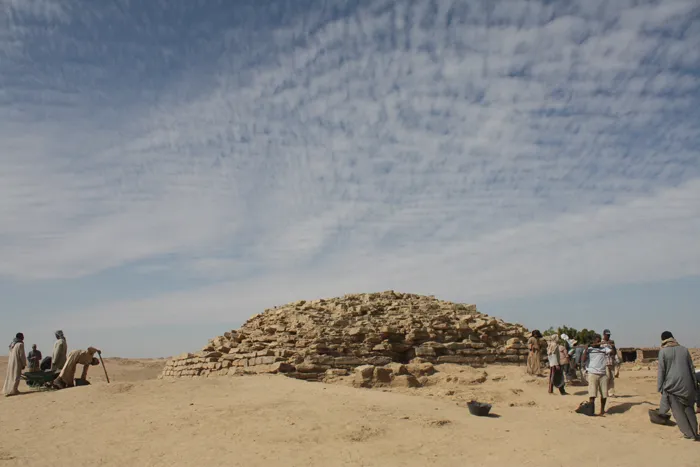
Archaeologists working near the ancient settlement of Edfu in southern Egypt have uncovered a step pyramid that dates back about 4,600 years. It predates the Great Pyramid at Giza by at least a few decades and was constructed by either Huni or Snefru, both pharaohs of Egypt. The newly uncovered pyramid contains no chambers and no evidence that it was originally intended for burial. It rose as high as 43 feet when it was first built but now rises only about 16 feet because of weathering and the pillaging of some of its stone blocks. This image shows excavations occurring at the pyramid’s eastern face during the 2011 season.
Provincial pyramids

The newly uncovered pyramid is one of seven so-called “provincial” pyramids that were built by either Huni or Snefru. None of the seven pyramids contain chambers or evidence that they were intended for burial. Located near major settlements all of these pyramids (except the one at Seila) have nearly identical dimensions indicating that they were built using a common plan. No provincial pyramids have yet been found in the Nile Delta, possibly because of preservation conditions.
A view from above

A satellite view showing the pyramid in 2005 (before work began) and 2013, after the project was conducted. Before 2010 the pyramid had never been excavated before although scholars were aware of its presence. The growth of a modern cemetery and nearby village posed a danger to the site.

A find in disguise

When the archaeologists first saw the site it did not look like a pyramid at all. It was covered in a thick layer of sand, modern waste and remains from pillaging of its blocks. People living in a nearby village thought that it was the tomb of a sheikh, a local Muslim saint, and did not realize that it is an ancient pyramid.
The revelation begins

As the team went to work cleaning the pyramid the monument began to reveal itself. This image shows the northwestern corner of the pyramid as it appeared in 2005 and after the last cleaning operations were finished n November 2012.
A fresh look

The southeastern corner of the pyramid in 2005 and after cleaning was complete.
The building process

The archaeologists found that the pyramid contained three steps and was built with sandstone blocks and clay mortar. A core of blocks was built vertically off the ground and two layers of blocks were built beside it, on top of each other. This gave the appearance of a pyramid with three steps.
Get the world’s most fascinating discoveries delivered straight to your inbox.
From whence it came

The quarry where the sandstone was extracted was discovered in 2011 and is located only 800 meters (about 870 yards) north of the pyramid.
A place of sacrifice

On the east side of the pyramid archaeologists found an installation where food offerings could have been made. The hole seen in this picture may have held a stela. Pieces of white limestone can also been seen and it appear that parts of this installation were removed around 1,500 years ago.
A cemetary as well

The remains of young children and babies were discovered around the pyramid. The burials date to long after the pyramid was built, perhaps a millennium. This image shows archaeologist Aurélie Schenk supervising the excavation of burials on the southern side of the pyramid.
Notes to loved ones

Hieroglyphic graffiti were discovered beside these burials and were dedicated to them. This image shows an inscription found on the lower courses of the northern face and is probably one of the oldest examples at this pyramid. Again along with the burials the graffiti dates to long after the pyramid was built.

Owen Jarus is a regular contributor to Live Science who writes about archaeology and humans' past. He has also written for The Independent (UK), The Canadian Press (CP) and The Associated Press (AP), among others. Owen has a bachelor of arts degree from the University of Toronto and a journalism degree from Ryerson University.