Get the world’s most fascinating discoveries delivered straight to your inbox.
You are now subscribed
Your newsletter sign-up was successful
Want to add more newsletters?
Delivered Daily
Daily Newsletter
Sign up for the latest discoveries, groundbreaking research and fascinating breakthroughs that impact you and the wider world direct to your inbox.
Once a week
Life's Little Mysteries
Feed your curiosity with an exclusive mystery every week, solved with science and delivered direct to your inbox before it's seen anywhere else.
Once a week
How It Works
Sign up to our free science & technology newsletter for your weekly fix of fascinating articles, quick quizzes, amazing images, and more
Delivered daily
Space.com Newsletter
Breaking space news, the latest updates on rocket launches, skywatching events and more!
Once a month
Watch This Space
Sign up to our monthly entertainment newsletter to keep up with all our coverage of the latest sci-fi and space movies, tv shows, games and books.
Once a week
Night Sky This Week
Discover this week's must-see night sky events, moon phases, and stunning astrophotos. Sign up for our skywatching newsletter and explore the universe with us!
Join the club
Get full access to premium articles, exclusive features and a growing list of member rewards.
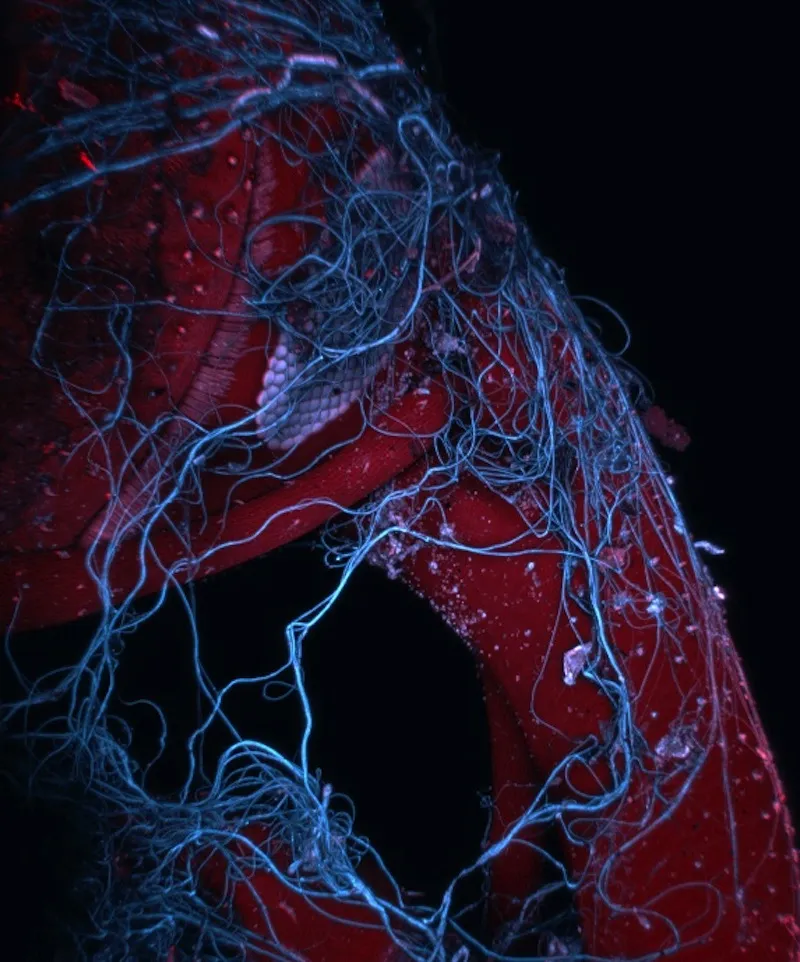
This amazing image is actually of an insect wrapped up in a spider web took ninth place at Nikon's 2013 Small World Photomicrography competition.
Mark A. Sanders from University Imaging Centers, University of Minnesota in Minneapolis, Minn. submitted the photo, which was created from stacked images magnified 85 times. He used autofluorescence and confocal optical imaging technique to capture the false-color photo.
Autofluorescence is the natural emission of light by biological structures when exposed to light they absorb, in this case the insect and spider web. Most biological structures and even some synthetic products, such as paper, have some degree of autofluorescence. Autofluorescence from U.S. paper currency is used to discern counterfeit from authentic money.
Sanders other technique, confocal optical imaging, is used to improve detail in an image by eliminating out-of-focus signals from the microscope. A conventional microscope "sees" as far into the specimen as the light can penetrate, while a confocal microscope only "sees" images one depth level at a time making each more controlled and focused. By stacking several images, Sanders is able to get a close-up view.
Follow LiveScience @livescience, Facebook & Google+.
Get the world’s most fascinating discoveries delivered straight to your inbox.