













Vaping: How E-cigs Work (Infographic)

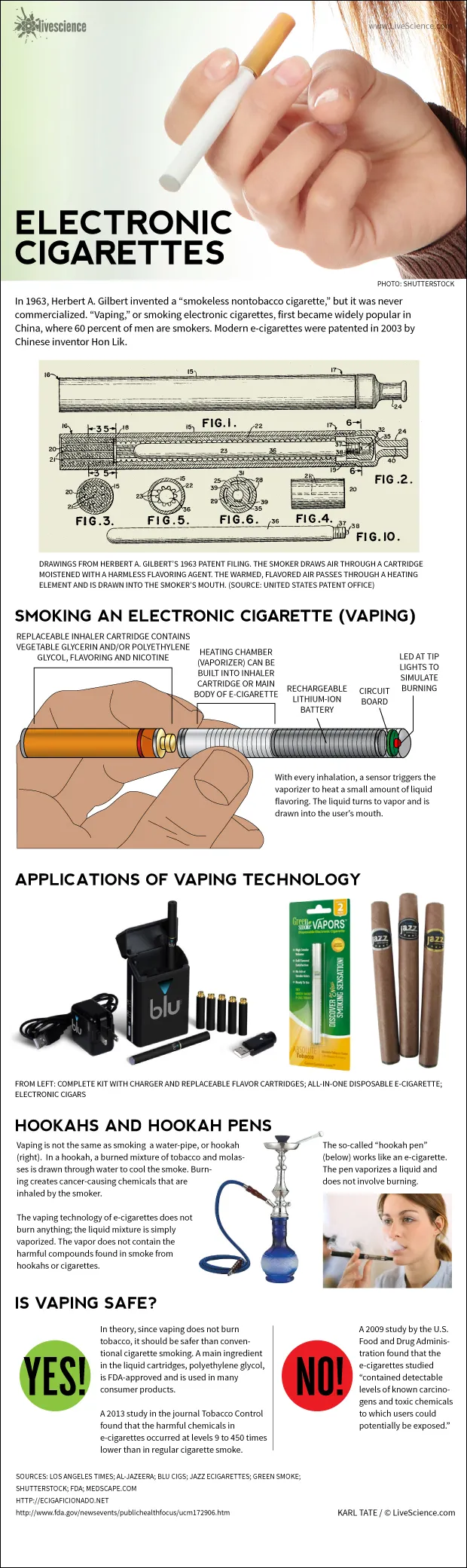
In 1963, Herbert A. Gilbert invented a “smokeless nontobacco cigarette,” but it was never commercialized. “Vaping,” or smoking electronic cigarettes, first became widely popular in China, where 60 percent of men are smokers. Modern e-cigarettes were patented in 2003 by Chinese inventor Hon Lik.
E-cigarettes feature a replaceable inhaler cartridge containing vegetable glycerin and/or polyethylene glycol, flavoring and nicotine. With every inhalation, a sensor triggers a vaporizer to heat a small amount of liquid flavoring. The liquid turns to vapor and is drawn into the user’s mouth.
Vaping is not the same as smoking a water-pipe, or hookah. In a hookah, a burned mixture of tobacco and molasses is drawn through water to cool the smoke. Burning creates cancer-causing chemicals that are inhaled by the smoker.
The vaping technology of e-cigarettes does not burn anything; the liquid mixture is simply vaporized. The vapor does not contain the harmful compounds found in smoke from hookahs or cigarettes.
The so-called “hookah pen” works like an e-cigarette. The pen vaporizes a liquid and does not involve burning.
In theory, since vaping does not burn tobacco, it should be safer than conventional cigarette smoking. A main ingredient in the liquid cartridges, polyethylene glycol, is FDA-approved and is used in many consumer products.
A 2013 study in the journal Tobacco Control found that the harmful chemicals in e-cigarettes occurred at levels 9 to 450 times lower than in regular cigarette smoke.
Get the world’s most fascinating discoveries delivered straight to your inbox.
A 2009 study by the U.S. Food and Drug Administration found that the e-cigarettes studied “contained detectable levels of known carcinogens and toxic chemicals to which users could potentially be exposed.”
Editor's Recommendations
