Get the world’s most fascinating discoveries delivered straight to your inbox.
You are now subscribed
Your newsletter sign-up was successful
Want to add more newsletters?
Delivered Daily
Daily Newsletter
Sign up for the latest discoveries, groundbreaking research and fascinating breakthroughs that impact you and the wider world direct to your inbox.
Once a week
Life's Little Mysteries
Feed your curiosity with an exclusive mystery every week, solved with science and delivered direct to your inbox before it's seen anywhere else.
Once a week
How It Works
Sign up to our free science & technology newsletter for your weekly fix of fascinating articles, quick quizzes, amazing images, and more
Delivered daily
Space.com Newsletter
Breaking space news, the latest updates on rocket launches, skywatching events and more!
Once a month
Watch This Space
Sign up to our monthly entertainment newsletter to keep up with all our coverage of the latest sci-fi and space movies, tv shows, games and books.
Once a week
Night Sky This Week
Discover this week's must-see night sky events, moon phases, and stunning astrophotos. Sign up for our skywatching newsletter and explore the universe with us!
Join the club
Get full access to premium articles, exclusive features and a growing list of member rewards.
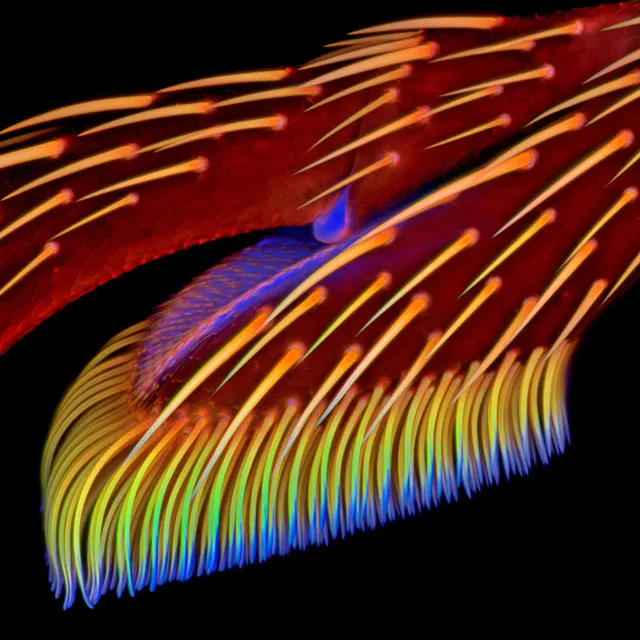
What looks like a vivid, prickly broom is actually an adhesive pad on a foreleg of Coccinella septempunctata, or ladybird beetle (also called a ladybug). Dr. Jan Michels of the Christian-Albrechts-Universität zu Kiel in Germany, captured the image of the beetle's foreleg at 20x magnification using autofluorescence and the optical imaging technique confocal microscopy. ("The key to the confocal approach is the use of spatial filtering to eliminate out-of-focus light or flare in specimens that are thicker than the plane of focus," according to the Nikon microscopy website.)
These beetles have distinctive spots and bright coloring to make them unappealing to predators. The coloring reminds possible threats that ladybird beetles would taste awful if preyed upon. Creatures not deterred by the ladybird's coloring will taste a foul fluid secreted by its leg.
The photo was among the winners at Nikon's 2013 Small World microphotography competition, where it placed seventh.
Follow LiveScience @livescience, Facebook & Google+.
Get the world’s most fascinating discoveries delivered straight to your inbox.