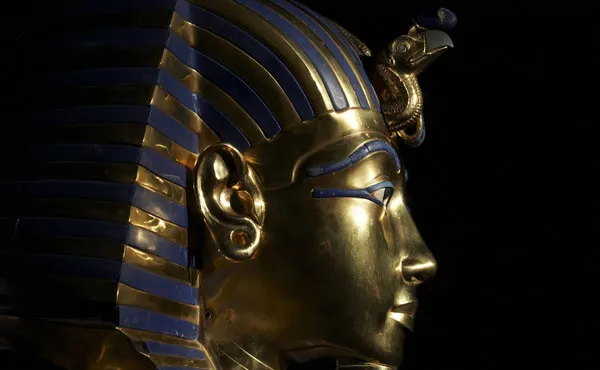
Though the famed Egyptian pharaoh King Tutankhamun died more than 3,300 years ago, the mystery surrounding his death and mummification continues to haunt scientists.
Now, British researchers believe they've found evidence explaining how the boy king died and, in the process, made a shocking discovery: After King Tut was sealed in his tomb in 1323 B.C., his mummified body caught fire and burned.
Since Egyptologists Lord Carnarvon and Howard Carter uncovered King Tut's tomb in 1922, their discovery has been shrouded in mystery and fear. A "curse of the mummy's tomb" entered the popular imagination after several members of the archaeological team died untimely deaths. [Image Gallery: The Beautiful Sarcophagus of an Egypt Pharaoh]
Latest Videos From
Archaeologist Chris Naunton, director of the Egypt Exploration Society, recently came across comments in Carter's original notes stating that King Tut's body appeared to have been burned, the Independent reports. Naunton then contacted Egyptologist Robert Connolly of Liverpool University, who had small samples of Tutankhamun's bones and flesh in his office.
When the team examined the pharaoh's remains under an electron microscope, they found that the pharaoh's flesh did, indeed, burn after he was laid to rest inside a sealed tomb — an extremely odd event, given the meticulous attention usually afforded the mummification of a king.
These and other revelations are detailed in a new British documentary, "Tutankhamun: The Mystery of the Burnt Mummy," featuring Naunton's investigative work (which has not yet been published in a peer-reviewed journal). But how would the fire in Tut's sealed tomb have occurred?
A hasty burial
Experts suspect the oils used in the embalming process soaked the linen that formed the king's burial shroud. In the presence of oxygen, these flammable oils started a chain reaction that ignited and "cooked" Tutankhamun's body at temperatures exceeding 390 degrees Fahrenheit (200 degrees Celsius).
For years, evidence has suggested the pharaoh was buried in haste — spots on the walls of Tut's tomb caused by microbial activity, for example, led researchers to believe that the paint on the walls hadn't even dried before the tomb was sealed. The additional evidence of an accidental burning lends credence to the idea that Tut's entire burial was basically a rush job.
"The charring and possibility that a botched mummification led to the body spontaneously combusting shortly after burial was entirely unexpected — something of a revelation," said Naunton, as quoted in the Independent.
Is spontaneous combustion real?
Spontaneous human combustion, once considered an impossibility, has received renewed interest from scientists worldwide. British biologist and author Brian Ford believes that flammable acetone produced by a body could — in the presence of a spark from static electricity or some other ignition source — cause a human body to catch fire and burn.
And by analyzing the injuries sustained by car-crash victims, forensic scientists have now shed light on the events surrounding the death of the boy king, who is believed to have been just 17 years old when he died.
Investigators were able to determine that the young pharaoh was on his knees when a horrific chariot accident smashed his rib cage, shattered his pelvis and crushed many of his internal organs, including his heart, according to the Guardian. This may explain why his heart was never found in his mummified body.
Follow Marc Lallanilla on Twitter and Google+. Follow us @livescience, Facebook & Google+. Original article on LiveScience.

 Live Science Plus